
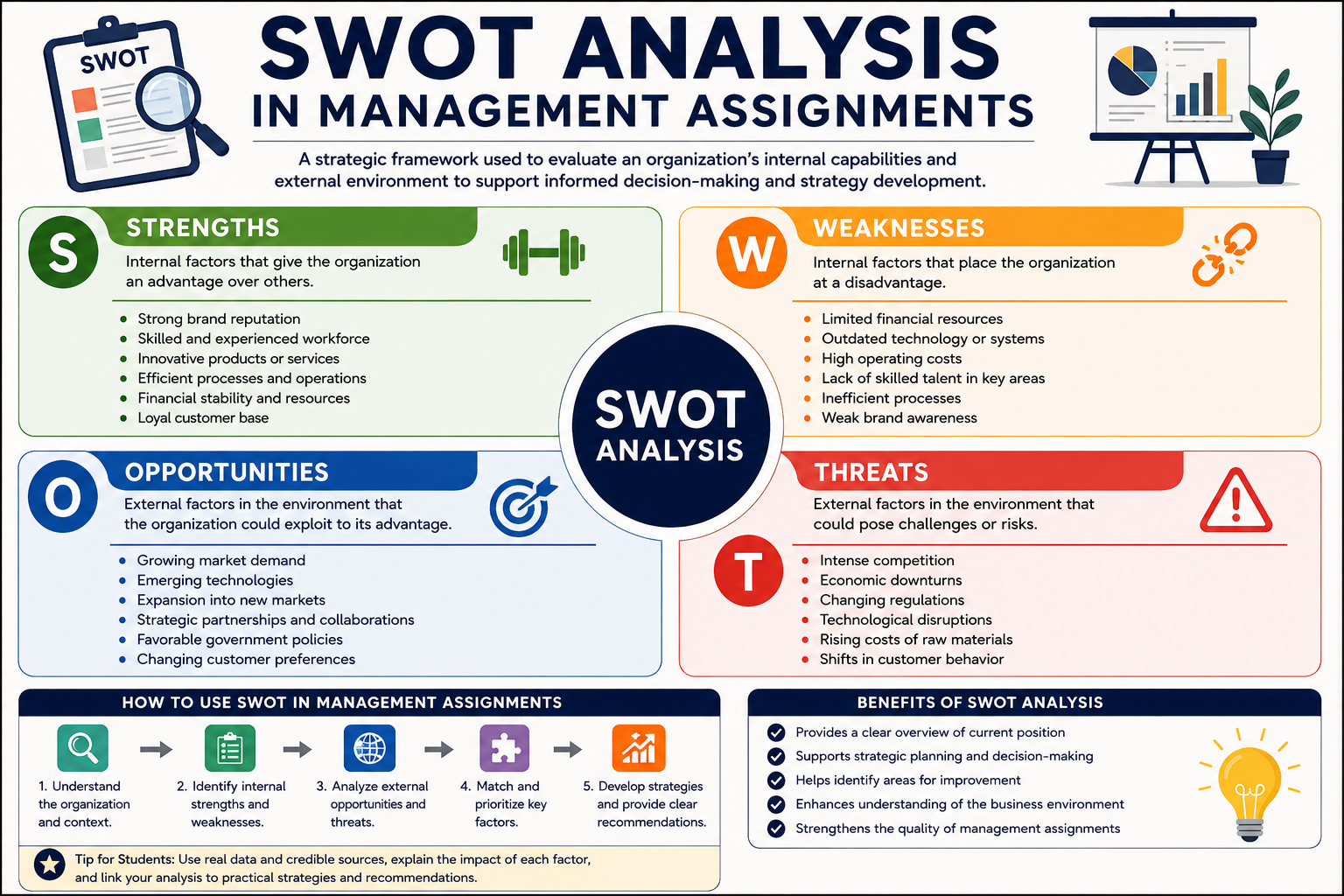
SWOT analysis is one of the most widely used strategic management frameworks for evaluating an organisation’s internal capabilities and external business environment. The term SWOT represents Strengths, Weaknesses, Opportunities, and Threats. The framework provides a structured method for identifying factors that may influence an organisation’s performance, competitiveness, strategic direction, and future growth. In management assignments, SWOT analysis is particularly useful because it allows students to connect theoretical concepts with practical business situations and demonstrate their ability to evaluate strategic issues critically.
A well-developed SWOT analysis should not simply present four lists of positive and negative factors. Instead, it should interpret how internal strengths and weaknesses interact with external opportunities and threats. This makes SWOT analysis an effective tool for strategic decision-making, business planning, market analysis, organisational evaluation, and management recommendations.
For university management assignments, students are generally expected to move beyond description and demonstrate analysis. This means explaining why a particular factor is important, supporting claims with credible evidence, and showing how the findings can influence management decisions. A strong SWOT analysis therefore combines theoretical understanding, business evidence, critical thinking, and practical recommendations.
Understanding the SWOT Framework
SWOT analysis divides strategic factors into two broad categories: internal factors and external factors. Strengths and weaknesses are generally considered internal factors because they relate to characteristics and resources within an organisation. Opportunities and threats are external factors because they arise from the organisation’s wider business environment.
The four components can be understood as follows.
Strengths
Strengths are the internal capabilities, resources, competencies, or characteristics that provide an organisation with an advantage over competitors. Examples may include a strong brand reputation, skilled employees, advanced technology, financial resources, efficient supply chains, customer loyalty, intellectual property, or an established market position.
For example, a technology company may have a strong research and development department and a recognised brand. These capabilities could allow the organisation to introduce innovative products more quickly than competitors. In a management assignment, however, it is not sufficient to state that the company has “strong technology.” The student should explain how this capability contributes to competitive advantage and whether the advantage is sustainable.
Weaknesses
Weaknesses are internal limitations that may reduce organisational performance or place a company at a disadvantage. Examples include high operating costs, limited financial resources, inadequate employee skills, poor customer service, outdated technology, weak management systems, excessive dependence on a single market, or inefficient business processes.
For example, a company may have strong sales but poor inventory management. This weakness could result in stock shortages, increased costs, customer dissatisfaction, and lost revenue. A good management assignment should establish the relationship between the weakness and its potential business consequences.
Opportunities
Opportunities are favourable external conditions that an organisation could potentially exploit to improve performance or achieve strategic objectives. These may arise from technological developments, changing consumer preferences, market expansion, demographic changes, new regulations, internationalisation, partnerships, or emerging customer segments.
For instance, growing demand for environmentally sustainable products may create an opportunity for a manufacturing organisation to develop environmentally friendly product lines. However, an opportunity becomes strategically valuable only when the organisation possesses the resources and capabilities required to exploit it effectively.
Threats
Threats are external factors that could negatively affect an organisation’s performance, profitability, reputation, or competitive position. Examples include new competitors, economic downturns, changing regulations, technological disruption, inflation, supply-chain problems, changing customer behaviour, cybersecurity risks, and substitute products.
A threat should be analysed in terms of its likelihood and potential impact. For example, increased competition may threaten market share, but the degree of risk will depend on the strength of competitors, customer switching costs, product differentiation, and the organisation’s ability to respond.
Importance of SWOT Analysis in Management Assignments
SWOT analysis is valuable in management assignments because it provides a logical structure for evaluating complex business problems. Organisations operate in environments characterised by uncertainty, competition, technological change, and changing stakeholder expectations. SWOT helps students organise these factors into a framework that can support strategic interpretation.
One major benefit is that SWOT connects internal capabilities with external conditions. An organisation may have an attractive market opportunity, but if it lacks the financial resources or technical capabilities to exploit that opportunity, the opportunity may not be immediately achievable. Similarly, an organisation may possess significant strengths that could help it respond to external threats.
SWOT analysis also encourages students to think strategically. Instead of focusing only on historical performance, students can consider what the organisation should do in the future. The analysis can therefore serve as a foundation for recommendations concerning market expansion, product development, cost reduction, innovation, human resource management, digital transformation, or competitive strategy.
Another important advantage is its flexibility. SWOT can be applied to large multinational corporations, small businesses, non-profit organisations, educational institutions, products, departments, projects, and even specific strategic initiatives.
How to Conduct a SWOT Analysis
A strong SWOT analysis should follow a systematic process.
Step 1: Understand the Organisation
Before creating a SWOT matrix, students should develop a clear understanding of the organisation being analysed. This includes its industry, products or services, target customers, competitors, business model, geographical markets, and strategic objectives.
Reliable sources such as annual reports, company publications, government statistics, industry reports, academic research, and reputable business publications can help establish the organisational context.
Step 2: Identify Internal Factors
Students should examine the organisation’s resources and capabilities to identify strengths and weaknesses. Important areas may include:
- Financial performance
- Human resources
- Brand reputation
- Technology
- Operations
- Marketing capabilities
- Customer relationships
- Supply-chain management
- Organisational culture
- Leadership
- Innovation
- Intellectual property
The focus should be on factors that have strategic significance rather than minor operational details.
Step 3: Examine the External Environment
The next step is to identify opportunities and threats. Students can examine market trends, economic conditions, technological developments, social changes, political factors, legal requirements, environmental concerns, and competitive forces.
Using another framework such as PESTLE analysis or Porter’s Five Forces can strengthen the external analysis. These frameworks can provide evidence that helps students identify and explain opportunities and threats.
Step 4: Evaluate Strategic Significance
Not every factor deserves equal attention. Students should assess each factor according to its potential impact on organisational objectives.
For example, if a company operates in an industry where artificial intelligence is rapidly changing customer expectations, technological capability may represent a major strength or weakness. By contrast, a minor change in office facilities may have little strategic significance.
Step 5: Develop Strategic Implications
The final and most important stage is to determine what management should do with the findings. Students should identify strategies that use strengths to exploit opportunities, use strengths to reduce threats, address weaknesses that prevent opportunities from being exploited, and minimise weaknesses that increase exposure to threats.
SWOT Matrix for Management Assignments
A SWOT matrix can be presented in four sections:
Internal FactorsPositiveNegativeInternalStrengths: Brand reputation, skilled employees, financial resources, technologyWeaknesses: High costs, skills gaps, outdated systems, limited market presenceExternalOpportunities: New markets, emerging technologies, changing consumer demandThreats: Competition, economic uncertainty, regulation, substitutesThe matrix is useful for presenting findings clearly, but students should not rely on the table alone. Each major factor should be explained in the accompanying discussion.
From SWOT Analysis to Strategy
One of the strongest ways to use SWOT in a management assignment is to develop strategic options from the four categories.
A Strength–Opportunity (SO) strategy uses organizational strengths to take advantage of external opportunities. For example, a company with strong digital capabilities may use emerging e-commerce demand to expand into new markets.
A Strength–Threat (ST) strategy uses internal strengths to reduce or manage external threats. A company with strong customer loyalty, for instance, may be better positioned to defend its market share against new competitors.
A Weakness–Opportunity (WO) strategy focuses on reducing internal weaknesses so the organization can exploit an opportunity. If a company identifies international expansion as an opportunity but lacks international management expertise, it may need to recruit specialists or develop employee capabilities.
A Weakness–Threat (WT) strategy aims to reduce weaknesses and protect the organization against threats. This could involve restructuring, reducing unnecessary costs, diversifying suppliers, improving cybersecurity, or strengthening risk-management systems.
This approach transforms SWOT from a descriptive framework into a decision-making tool.
Using Evidence in a SWOT Analysis
Evidence is essential for a high-quality management assignment. Students should avoid making unsupported statements such as “the company has a strong brand” or “competition is increasing.” Instead, they should demonstrate why these claims are reasonable.
For example, evidence might include revenue trends, market-share data, customer surveys, employee statistics, industry forecasts, competitor information, or findings from peer-reviewed academic literature.
Academic sources are particularly important when explaining theoretical concepts. Business and industry sources can then be used to support organization-specific claims. A combination of academic and credible industry evidence can make the analysis more convincing.
Students should also distinguish between facts and interpretations. A fact might be that an organization's operating costs increased over a specific period. The interpretation could be that rising costs represent a weakness because they may reduce profitability and limit the organization's ability to compete on price.
Critical Analysis of SWOT
Although SWOT is useful, it has several limitations. One criticism is that SWOT can become overly simplistic. Complex business environments cannot always be accurately represented through four categories. Some factors may simultaneously represent strengths and weaknesses depending on the situation.
For example, a large organizational structure may provide significant resources and economies of scale but may also create bureaucracy and slow decision-making. Therefore, students should avoid treating SWOT categories as absolute.
Another limitation is subjectivity. Different managers may classify the same factor differently. A strong analytical approach should therefore explain the reasoning behind each classification and support important claims with evidence.
SWOT can also provide a static view of a dynamic environment. External conditions may change quickly, particularly in industries affected by technology, regulation, global competition, or changing consumer behavior. Consequently, SWOT should ideally be combined with other strategic tools.
Another weakness is that SWOT does not automatically establish priorities. A company may identify ten strengths and ten threats, but the framework does not necessarily indicate which factor is most important. Students can overcome this limitation by ranking factors according to impact, urgency, probability, and strategic relevance.
Common Mistakes Students Make
Several common mistakes can reduce the quality of SWOT analysis in management assignments.
The first is confusing internal and external factors. For example, “increasing competition” is a threat rather than a weakness because competition originates outside the organization.
The second mistake is providing generic factors without explanation. Simply writing “good employees” under strengths does not demonstrate strategic analysis. Students should explain what capabilities employees provide and how those capabilities contribute to organizational objectives.
The third mistake is failing to connect SWOT findings with recommendations. A SWOT table that is not used to develop strategic implications provides limited value.
Another common problem is excessive reliance on unsupported opinions. Claims should be supported through credible evidence whenever appropriate.
Students should also avoid including too many factors. A long list of minor issues can make the analysis less focused. It is usually more effective to identify a smaller number of strategically significant factors and analyze them in depth.
Finally, students should avoid treating SWOT as the entire strategic analysis. Other frameworks may provide deeper insights into industry competition, macro-environmental changes, resources, capabilities, and stakeholder relationships.
Integrating SWOT with Other Management Frameworks
SWOT becomes more effective when combined with complementary management frameworks.
PESTLE analysis can help identify political, economic, social, technological, legal, and environmental factors that may create opportunities or threats.
Porter’s Five Forces can help evaluate industry competition, supplier power, buyer power, substitute products, and the threat of new entrants.
VRIO analysis can be used to assess whether organizational resources are valuable, rare, difficult to imitate, and effectively organized.
Ansoff’s Matrix can help develop growth strategies based on market penetration, market development, product development, and diversification.
Combining these frameworks can demonstrate stronger theoretical understanding and provide a more comprehensive strategic assessment.
Example of SWOT Application
Consider a hypothetical Australian retail company seeking to expand its online operations. Its strengths may include strong customer relationships, an established brand, and experienced employees. Its weaknesses could include an outdated online platform, limited digital marketing expertise, and relatively high operating costs.
The external environment may provide opportunities through increasing online shopping demand, improved digital payment systems, and access to wider geographic markets. At the same time, threats could include international competitors, cybersecurity risks, price competition, and changing customer expectations.
The SWOT findings could support a strategy focused on digital transformation. The company could use its existing customer base and brand reputation to promote its online platform while investing in website development and digital marketing capabilities. It could also strengthen cybersecurity systems to reduce technological risks.
This example demonstrates why SWOT should not end with the identification of four categories. The purpose of the framework is to help management identify practical strategic responses.
Conclusion
SWOT analysis is an effective and accessible strategic management framework for analyzing the internal and external factors affecting an organization. In management assignments, it enables students to demonstrate their understanding of organizational strengths, weaknesses, market opportunities, and external threats. However, a high-quality SWOT analysis should move beyond a simple four-box matrix.
Students should begin by establishing a clear understanding of the organization and its strategic environment. They should then identify significant internal and external factors, support their observations with credible evidence, evaluate the strategic importance of those factors, and develop realistic management recommendations.
The strongest assignments use SWOT as part of a broader analytical process rather than treating it as an isolated technique. Combining SWOT with frameworks such as PESTLE, Porter’s Five Forces, VRIO, or Ansoff’s Matrix can provide deeper insights and strengthen strategic recommendations.
Ultimately, the value of SWOT analysis lies in its ability to connect organizational capabilities with environmental conditions. When used critically and supported by reliable evidence, it can help management students explain not only where an organization currently stands, but also what strategic actions it should consider for future performance and competitive advantage.