
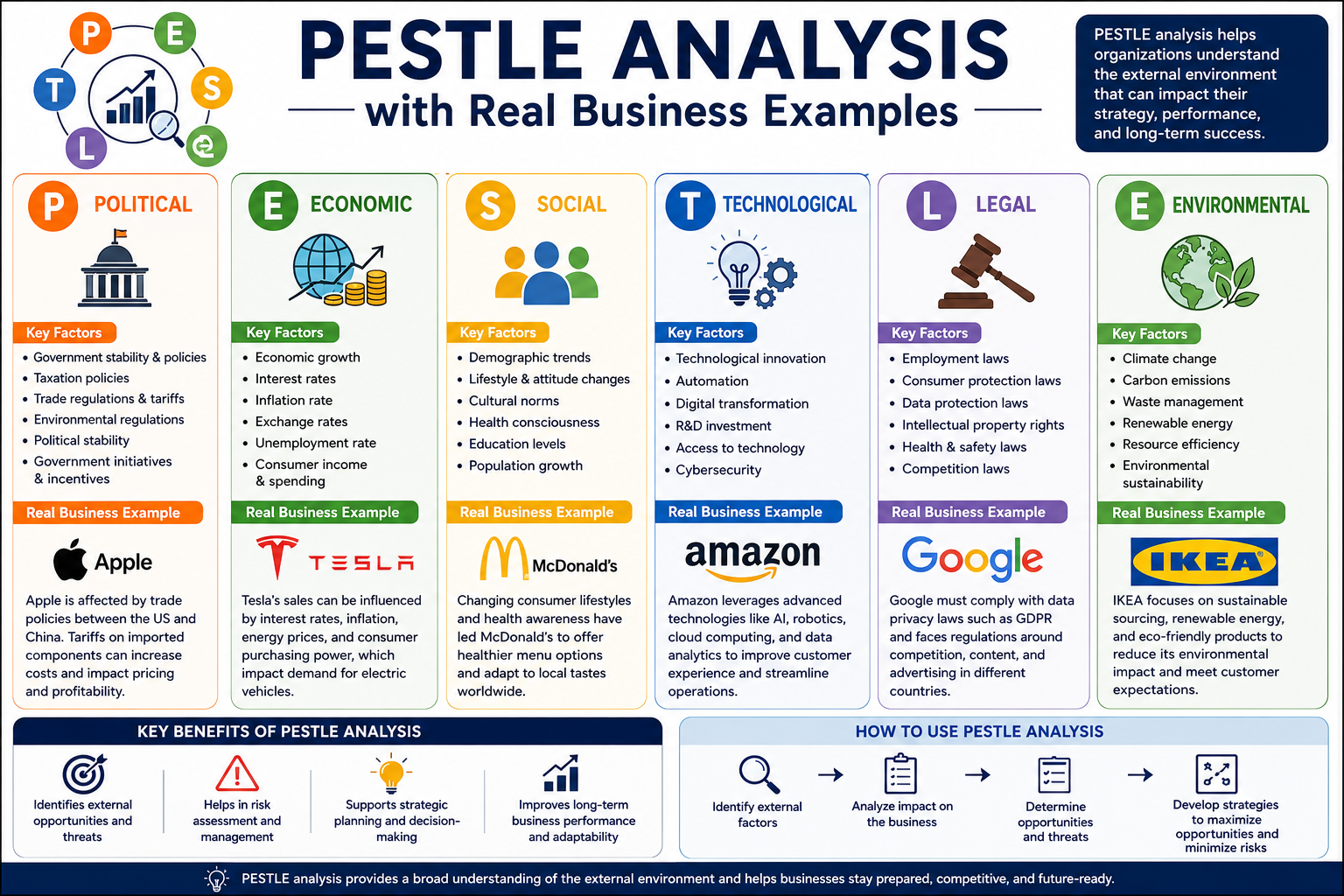
PESTLE analysis is a widely used strategic management framework that helps organizations understand the external factors that can influence their performance, operations, competitiveness, and long-term growth. The term PESTLE represents Political, Economic, Social, Technological, Legal, and Environmental factors. Unlike internal analysis tools such as SWOT, which examine an organization's strengths and weaknesses, PESTLE focuses primarily on the wider external environment in which a business operates.
Businesses do not operate in isolation. Government policies, economic conditions, consumer behavior, technological innovation, legislation, and environmental concerns can significantly affect business decisions. For example, changes in trade policies can affect the cost of imported products, inflation can influence consumer spending, technological developments can create new business models, and environmental regulations can require companies to change their production processes.
PESTLE analysis is therefore particularly useful for management assignments because it enables students to demonstrate how external environmental factors influence real businesses. However, an effective PESTLE analysis should go beyond simply listing factors. Students should explain the impact of each factor, provide relevant business examples, and evaluate how organizations can respond strategically.
This article explains each element of PESTLE analysis and illustrates its application through real business examples.
What Is PESTLE Analysis?
PESTLE analysis is a strategic tool used to examine the macro-environmental factors that may affect an organisation. These factors are generally outside the direct control of the business, but they can create opportunities or threats.
The six components are:
- Political
- Economic
- Social
- Technological
- Legal
- Environmental
The framework can be used by organizations before entering a new market, launching a product, developing a business strategy, evaluating risks, or making long-term investment decisions.
For example, a company considering expansion into another country could use PESTLE analysis to examine government stability, economic growth, cultural preferences, technology infrastructure, employment regulations, and environmental requirements before committing resources.1. Political Factors
Political factors refer to government actions, policies, political stability, taxation, trade policies, government spending, international relations, and other political conditions that may influence businesses.
Governments can affect businesses through taxation, import and export regulations, subsidies, tariffs, employment policies, industry regulations, and public-sector investment. Political instability can also increase uncertainty and operational risk.
Real Business Example: Apple
Apple operates a highly international supply chain, with manufacturing and component sourcing spread across multiple countries. Consequently, international trade policies and relationships between major economies can affect its supply chain and costs.
Changes in tariffs, trade restrictions, or government policies can influence the cost of importing components or exporting finished products. Apple therefore has to consider geopolitical developments when making supply-chain and manufacturing decisions.
This demonstrates how political factors can influence a company's operational strategy even when the political issue does not directly concern the company's products.
Real Business Example: McDonald's
McDonald's operates in many countries and must adapt its business operations to local political and regulatory environments. Government policies relating to food safety, employment, taxation, imports, and franchising can influence restaurant operations.
A political environment that supports international investment may create opportunities for expansion, while restrictive regulations or political instability may increase business risk.
Management Implication
Businesses can respond to political risks through geographic diversification, stakeholder engagement, scenario planning, flexible supply chains, and continuous monitoring of government policy.
For a management assignment, students should explain not only that political factors exist but also how they influence costs, market access, investment decisions, supply chains, or strategic planning.
2. Economic Factors
Economic factors are among the most important external influences on business performance. They include inflation, interest rates, unemployment, economic growth, exchange rates, consumer income, purchasing power, and overall economic conditions.
When economic conditions are strong, consumers may have greater disposable income and businesses may increase investment. During periods of economic uncertainty, consumers may reduce spending while businesses may delay expansion.
Real Business Example: Tesla
Tesla's performance can be influenced by interest rates, consumer purchasing power, energy prices, and broader economic conditions.
Electric vehicles generally involve significant consumer expenditure. When borrowing costs increase, financing a vehicle can become more expensive, potentially affecting consumer demand. Inflation can also increase production costs, including labour, raw materials, logistics, and components.
Tesla therefore needs to consider economic conditions when determining pricing, production, investment, and expansion strategies.
Real Business Example: Walmart
Walmart provides another useful example of economic influences. During periods when household budgets are under pressure, consumers may become more price-conscious and seek lower-cost products.
A retailer positioned around value and competitive pricing may potentially benefit from changes in consumer purchasing behaviour. However, inflation can simultaneously increase the retailer's costs, including wages, transportation, energy, and supplier prices.
This demonstrates that one economic factor can create both opportunities and threats.
Management Implication
Businesses can respond to economic uncertainty by controlling costs, adjusting pricing strategies, diversifying markets, improving operational efficiency, and monitoring consumer purchasing behaviour.
In an assignment, students should connect economic indicators with measurable business outcomes such as revenue, profit margins, demand, operating costs, and investment.
3. Social Factors
Social factors relate to population characteristics, lifestyles, cultural attitudes, consumer preferences, education, demographics, health awareness, social values, and changes in customer behaviour.
Changes in society can create major opportunities for businesses because customer expectations are constantly evolving.
Real Business Example: McDonald's
McDonald's has had to respond to changing consumer preferences concerning health, convenience, menu variety, and dietary choices.
Consumers in different markets may have different cultural preferences and dietary requirements. As a global company, McDonald's adapts menus and marketing strategies to local markets.
For example, menu offerings may differ between countries because consumer tastes, cultural expectations, and dietary practices vary.
This illustrates the importance of social factors in international business strategy.
Real Business Example: Coca-Cola
Coca-Cola operates in a market where consumer attitudes towards health, sugar consumption, and wellness can influence demand.
Growing interest in healthier lifestyles has encouraged beverage companies to expand product portfolios beyond traditional sugary drinks. Businesses may introduce reduced-sugar, zero-sugar, water, or other beverage alternatives in response to changing consumer preferences.
Management Implication
Businesses should monitor demographic trends, customer expectations, cultural changes, lifestyle preferences, and social attitudes. Market research, customer feedback, social-media analysis, and consumer surveys can help organisations identify emerging trends.
In a management assignment, students should explain how social changes affect customer demand and how companies can adapt products, services, marketing, and communication strategies.
4. Technological Factors
Technology is one of the fastest-changing elements of the modern business environment. Technological factors include automation, artificial intelligence, digital platforms, e-commerce, cloud computing, cybersecurity, data analytics, mobile technology, and research and development.
Technological change can create opportunities for innovation while simultaneously making existing products, services, and business models obsolete.
Real Business Example: Amazon
Amazon demonstrates the strategic importance of technology in modern retail. Its business model relies heavily on digital platforms, data, automation, logistics technology, cloud computing, and artificial intelligence.
Technology allows Amazon to improve customer experience, manage large product inventories, optimise logistics, and provide personalised recommendations.
The example demonstrates that technology is not simply an operational tool. It can become a central component of an organisation's competitive strategy.
Real Business Example: Netflix
Netflix provides another strong example of technological disruption. The company moved away from the traditional physical DVD rental model and developed a streaming-based business model.
Advances in internet infrastructure, connected devices, data analytics, and streaming technology helped create a new entertainment consumption model.
Netflix also uses technology to analyze viewer behavior and support content recommendations.
Management Implication
Businesses should monitor emerging technologies and assess whether they can improve efficiency, customer experience, innovation, or competitive advantage. However, technological investment can also involve substantial costs and risks, including cybersecurity threats, privacy concerns, employee training requirements, and technology obsolescence.
For management assignments, students should explain both the opportunities and risks associated with technological change.
5. Legal Factors
Legal factors include laws and regulations that businesses must follow. These may include employment law, consumer protection, competition law, data protection, intellectual property rights, product safety requirements, taxation regulations, and industry-specific legislation.
Legal requirements can influence how businesses design products, manage employees, collect data, market products, and operate across different countries.
Real Business Example: Amazon
Amazon collects and processes large amounts of customer data through its online platforms. Data protection and privacy regulations can therefore affect how the company collects, stores, processes, and uses customer information.
Businesses operating internationally may also need to comply with different legal requirements in different jurisdictions.
Failure to comply with applicable laws can result in financial penalties, reputational damage, operational restrictions, or legal disputes.
Real Business Example: Google
Google operates in markets where competition, privacy, data protection, and digital regulation are increasingly important. Regulatory authorities in different jurisdictions have examined aspects of large technology companies' business practices.
This demonstrates that legal factors can influence not only day-to-day compliance but also broader strategic decisions and business models.
Management Implication
Organisations need effective compliance systems, legal monitoring, employee training, data-management policies, and risk-management procedures.
In a management assignment, students should identify relevant legislation and explain how it affects the organisation rather than simply stating that “laws affect businesses.”
6. Environmental Factors
Environmental factors refer to ecological and sustainability-related issues that influence businesses. These include climate change, carbon emissions, energy consumption, waste management, resource availability, pollution, environmental regulations, and consumer expectations regarding sustainability.
Environmental issues have become increasingly important because businesses face pressure from governments, consumers, investors, employees, and other stakeholders to reduce environmental impact.
Real Business Example: Tesla
Tesla provides a prominent example of a company whose business model is closely connected with environmental concerns. Electric vehicles are positioned as an alternative to conventional internal-combustion vehicles, particularly in the context of efforts to reduce transport emissions.
However, environmental analysis also requires consideration of issues such as battery production, raw materials, energy sources, manufacturing processes, and recycling.
This demonstrates why environmental analysis should be balanced rather than assuming that a business automatically has a positive environmental impact.
Real Business Example: IKEA
IKEA has also made sustainability an important part of its business strategy, including initiatives related to renewable energy, materials, product design, and circular-economy principles.
Environmental expectations can influence product development, sourcing, packaging, logistics, and supply-chain decisions.
Management Implication
Businesses can respond to environmental pressures through energy efficiency, sustainable sourcing, waste reduction, renewable energy, environmentally responsible product design, and transparent sustainability reporting.
In an assignment, students should evaluate how environmental factors affect both organisational costs and opportunities for innovation or competitive differentiation.
PESTLE Analysis Example: Tesla
A useful way to demonstrate PESTLE analysis in a management assignment is to apply the framework to a single organisation.
PESTLE FactorExample Influence on TeslaPoliticalGovernment policies, EV incentives, trade restrictions and industrial policyEconomicInterest rates, inflation, consumer purchasing power and raw-material costsSocialGrowing interest in sustainable transport and changing mobility preferencesTechnologicalBattery technology, autonomous-driving systems, AI and manufacturing automationLegalVehicle safety, employment, data, competition and regulatory requirementsEnvironmentalClimate concerns, emissions reduction, battery materials and recyclingThis table provides an overview, but a strong assignment should explain the strategic implications of each factor.
For example, government support for electric vehicles may create an opportunity for Tesla, while changes in subsidies or trade policy could create uncertainty. Advances in battery technology may improve vehicle performance and reduce costs, while increased regulatory requirements may require additional investment.
How to Use PESTLE Analysis in a Management Assignment
Students can follow a structured process when incorporating PESTLE into an assignment.
Step 1: Introduce the Organization
Begin by explaining the organization, industry, products or services, target market, and geographical scope.
Step 2: Explain the PESTLE Framework
Briefly define PESTLE and explain why the framework is relevant to the organization.
Step 3: Research External Factors
Use reliable sources to identify political, economic, social, technological, legal, and environmental developments.
Step 4: Analyze the Impact
Explain how each factor affects the organization. Consider whether the factor creates an opportunity, threat, cost, risk, or strategic requirement.
Step 5: Use Real Business Evidence
Support important claims with credible sources such as annual reports, government publications, industry research, academic literature, and reputable business sources.
Step 6: Develop Recommendations
Use the findings to propose realistic management actions. Recommendations should directly relate to the factors identified in the analysis.
Step 7: Conclude
Summaries the most important external influences and explain which factors management should priorities.
Advantages of PESTLE Analysis
PESTLE analysis provides several advantages for management decision-making.
1. Provides a Structured Framework
It organizes a wide range of external factors into six clearly defined categories.
2. Supports Strategic Planning
Understanding external trends can help organizations prepare for future opportunities and threats.
3. Encourages Environmental Awareness
PESTLE encourages managers to look beyond internal operations and consider the wider business environment.
4. Supports Risk Management
Identifying political, economic, legal, technological, and environmental risks can help businesses develop appropriate responses.
5. Helps Identify Opportunities
External changes are not always threats. Technological innovation, changing consumer behavior, or new government policies can create opportunities for growth.
Limitations of PESTLE Analysis
Despite its usefulness, PESTLE has limitations.
First, it can become too broad. Businesses operate in complex environments, and not every external factor is equally important.
Second, PESTLE provides limited prioritization. Identifying a factor does not automatically indicate how significant it is.
Third, the external environment can change rapidly. A PESTLE analysis may become outdated if political, economic, technological, or social conditions change.
Fourth, the framework does not directly analyze internal organizational capabilities. It should therefore be combined with frameworks such as SWOT or VRIO when a complete strategic assessment is required.
Finally, PESTLE can become descriptive if students simply list external factors without explaining their strategic consequences.
PESTLE vs SWOT Analysis
PESTLE and SWOT are complementary rather than competing frameworks.
PESTLE focuses primarily on the external macro-environment. It examines political, economic, social, technological, legal, and environmental conditions.
SWOT examines internal strengths and weaknesses as well as external opportunities and threats.
For example, a student analyzing an electric vehicle company could use PESTLE to identify environmental regulations, technological developments, economic conditions, and government incentives. These findings could then contribute to the opportunities and threats section of a SWOT analysis.
Using both frameworks can therefore provide a more comprehensive strategic analysis.
Tips for Writing a High-Quality PESTLE Assignment
Students should keep several principles in mind when using PESTLE in academic work.
Use current evidence: External conditions can change quickly, so recent and relevant information is important.
Avoid generic statements: Explain the specific impact of each factor on the selected organization.
Priorities important factors: Focus on factors that have significant strategic consequences.
Use real examples: Examples from companies such as Amazon, Tesla, Apple, McDonald's, Coca-Cola, Netflix, and IKEA can make the discussion more practical.
Link analysis to recommendations: Explain what management should do in response to the external environment.
Use credible sources: Academic journals, government reports, company reports, industry publications, and reputable business sources can strengthen the analysis.
Maintain critical thinking: Consider both positive and negative consequences. A technological development, for example, may create opportunities for innovation while also increasing cybersecurity or investment risks.
Conclusion
PESTLE analysis is a valuable strategic management framework for understanding the external factors that influence business organizations. By examining political, economic, social, technological, legal, and environmental conditions, managers can identify potential risks, opportunities, and strategic challenges.
Real businesses demonstrate the importance of each PESTLE category. Companies such as Apple are affected by international trade and political conditions; Tesla is influenced by economic, technological, environmental, and regulatory developments; Amazon operates within a rapidly changing technological and legal environment; and companies such as McDonald's and Coca-Cola must respond to changing consumer preferences and social expectations.
For students, the most important point is that PESTLE analysis should not be treated as a simple list of external factors. A strong management assignment explains what is changing, why it matters, how it affects the organization, and what management should do about it. Supporting the analysis with current evidence and real business examples makes the discussion more credible and academically valuable.
When combined with other strategic tools such as SWOT, Porter’s Five Forces, VRIO, or Ansoff’s Matrix, PESTLE can provide a comprehensive understanding of an organization's strategic environment. Ultimately, the framework helps businesses anticipate change, manage uncertainty, identify opportunities, and make better-informed strategic decisions.