
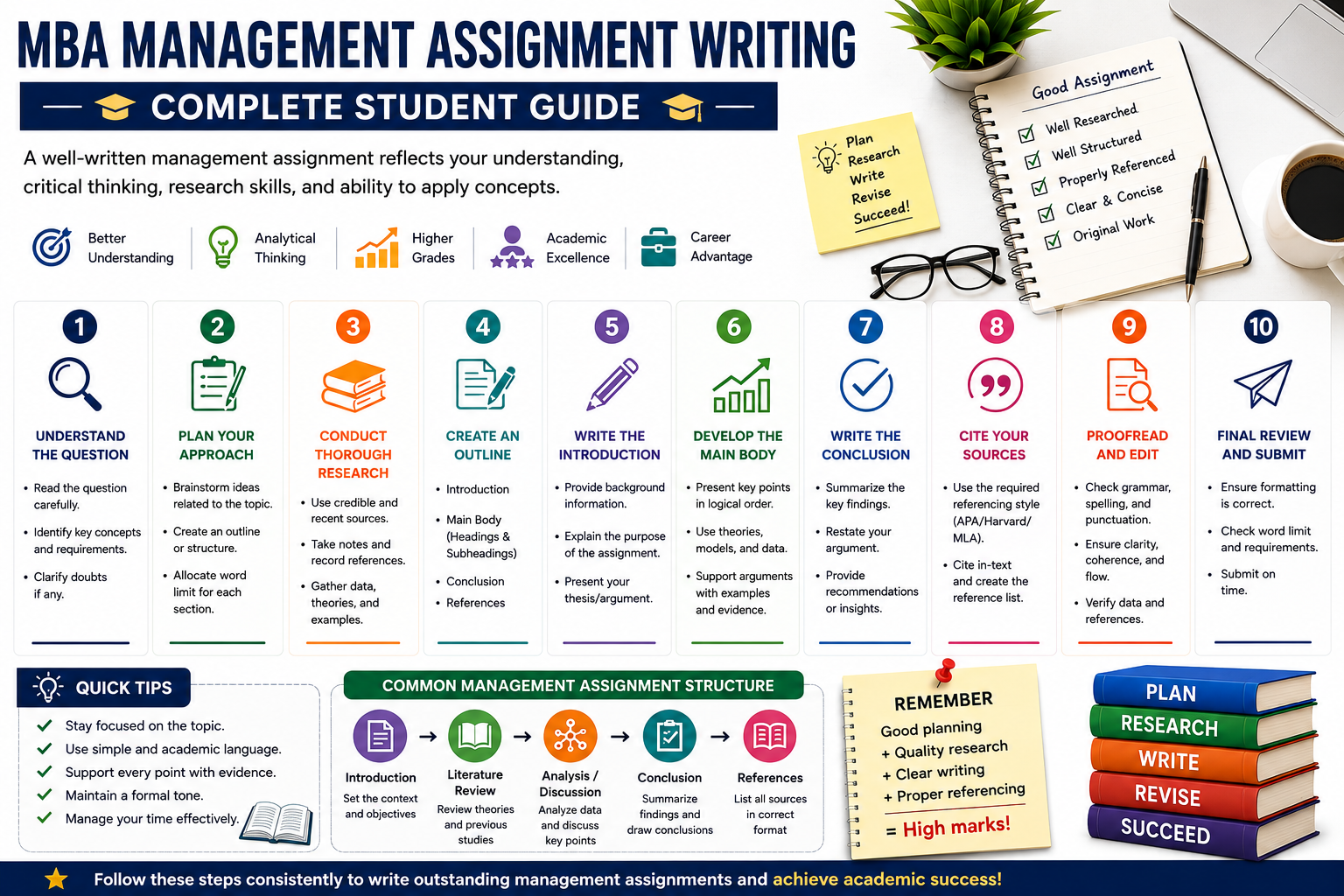
MBA programs demand a different caliber of writing than undergraduate business degrees. Assignments are expected to reflect not just knowledge of management theory, but the ability to apply that theory with the judgment of someone preparing to operate at a managerial or executive level. Tutors marking MBA work are typically looking for strategic thinking, real-world grounding, and a level of analytical rigor that goes beyond restating textbook frameworks.
This guide walks through what distinguishes strong MBA assignment writing, covering structure, research, analysis, and the specific expectations that set graduate-level business writing apart from undergraduate work.
What Makes MBA Writing Different
Many students entering an MBA program, particularly those coming directly from undergraduate business degrees, initially approach assignments the same way they did before. This is one of the most common early missteps. MBA assignments assume a baseline familiarity with core theory and instead reward the ability to critically evaluate, compare, and apply that theory to complex, often ambiguous real-world situations.
Where an undergraduate assignment might ask a student to explain a concept like organizational change management, an MBA assignment is more likely to present an ambiguous scenario — a merger, a leadership transition, a market disruption — and ask the student to recommend a course of action, justified by relevant theory and evidence. The shift is from "what do you know" to "what would you do, and why."
This distinction shapes nearly every aspect of how MBA assignments should be approached, from research strategy to final structure.
Understanding the Assignment Brief
MBA assignment briefs are often deliberately open-ended, which can initially feel disorienting to students used to more prescriptive undergraduate tasks. A brief might ask students to "critically evaluate" a company's strategic position or "recommend and justify" a course of action, without specifying exactly which frameworks or angles to use.
This ambiguity is intentional. Part of what's being assessed is the ability to independently identify which theories, models, and evidence are most relevant to a given situation, rather than being told which ones to apply. Spending time at the outset mapping out the specific question being asked, and what kind of answer would genuinely satisfy it, pays off considerably more at this level than it might in earlier coursework.
Research Expectations at MBA Level
MBA assignments are expected to draw on a wider and more current body of research than undergraduate work. This typically means going beyond core textbooks to incorporate:
- Peer-reviewed academic journal articles, particularly recent ones reflecting current thinking in the field
- Industry reports from recognized research firms
- Company disclosures such as annual reports, investor presentations, and regulatory filings
- Reputable business journalism from outlets covering the specific industry or company in question
A common mistake at this level is relying too heavily on a small number of secondary or introductory sources. MBA-level work is expected to synthesize multiple, sometimes conflicting, sources into a coherent argument, rather than leaning on a single dominant framework or textbook chapter.
Given the pace at which business environments change, currency of sources also matters more here than in many other academic disciplines. A five-year-old market analysis of a fast-moving industry may no longer accurately represent the competitive landscape being discussed.
Structuring an MBA Assignment
While specific structural requirements vary between programs and assignment types, most MBA assignments — whether case studies, strategic reports, or reflective pieces — benefit from a few consistent structural principles.
A clearly framed introduction. Rather than a general opening, strong MBA introductions typically state the specific issue being addressed, the scope of the analysis, and often a brief indication of the argument or recommendation to follow.
Analysis grounded in evidence, not assumption. Each analytical section should draw on specific data, whether financial figures, market research, or documented organizational detail, rather than general assumptions about how companies or industries typically behave.
Explicit engagement with alternative perspectives. MBA-level critical evaluation often involves acknowledging competing viewpoints or alternative strategic options, and explaining why one is favored over another, rather than presenting a single interpretation as the only reasonable one.
Recommendations that acknowledge constraints. Strong recommendations at this level don't just state what should be done, but engage with the practical constraints — financial, organizational, cultural, regulatory — that would affect implementation.
A conclusion that reinforces the core argument. Rather than summarizing everything covered, an effective MBA conclusion typically restates the central argument or recommendation clearly, reflecting the specific question the assignment brief posed.
Applying Frameworks Without Over-Relying on Them
Frameworks like SWOT, PESTLE, Porter's Five Forces, and the BCG Matrix remain useful tools in MBA writing, but a common critique from tutors is that students lean on these frameworks as a substitute for original analysis rather than a starting point for it.
A framework should structure thinking, not replace it. Filling in a SWOT grid with generic points about a company is rarely sufficient at MBA level; what matters is the analysis that follows — why a particular strength matters strategically, how a specific threat interacts with the company's existing constraints, and what that implies for the recommendation being built toward.
Where possible, combining or adapting frameworks to fit the specific situation, rather than applying a single model in isolation, often produces a more sophisticated and convincing analysis.
Referencing and Academic Integrity
Referencing expectations at MBA level are generally consistent with those at undergraduate level in terms of format — most programs require Harvard or APA referencing — but the volume and diversity of sources typically used is higher, which raises the stakes for accuracy and consistency.
Given the heavier use of corporate and industry sources alongside academic literature, MBA students should pay particular attention to correctly citing non-traditional source types: annual reports, market research databases, regulatory filings, and executive interviews or speeches. Each referencing style has conventions for organizational authorship that apply well to these source types once understood.
Academic integrity concerns also extend beyond formal citation. Many MBA programs place strong emphasis on originality of analysis, given how widely available case studies and company data are. Two students analyzing the same public company should still arrive at distinguishable arguments if their critical thinking is genuinely their own.
Common Pitfalls Specific to MBA Assignments
A few issues tend to appear disproportionately often in MBA-level work specifically, beyond the general mistakes seen across management education broadly.
Overconfidence without evidence. MBA students, often bringing significant professional experience, sometimes substitute personal workplace experience for evidence-based analysis. While professional insight can add value, it should generally support rather than replace research-grounded argument.
Underestimating the value of quantitative analysis. Assignments involving financial performance, market sizing, or operational metrics are strengthened considerably by actual calculation and data interpretation, rather than purely qualitative discussion of numbers referenced from a report.
Failing to tailor generic case study knowledge. Popular case studies — well-known company turnarounds, high-profile mergers, famous leadership transitions — are widely written about, and it can be tempting to draw heavily on existing commentary rather than developing original analysis specific to the assignment's actual question.
Inconsistent tone. MBA writing sits between academic and professional register. Overly casual language undermines credibility, but writing that is needlessly dense or jargon-heavy can obscure otherwise strong analysis. The clearest MBA writing tends to favor precision over complexity.
Time Management for MBA Assignments
MBA students are frequently balancing coursework with full-time employment, group projects, and networking commitments, making time management a more acute challenge than it typically is at undergraduate level. Given the depth of research and structural rigor expected, starting assignments well before the deadline is particularly important — MBA-level analysis rarely improves under last-minute time pressure the way lighter undergraduate tasks sometimes can.
Breaking the writing process into distinct phases — research and framework selection, drafting, evidence integration, and a dedicated formatting and referencing review — tends to produce stronger results than attempting to complete an assignment in one continuous session.
Writing for Different MBA Assignment Formats
MBA programs use a range of assignment formats, and each carries slightly different expectations that are worth understanding before drafting begins.
Case study analyses typically ask students to step into a decision-making role within a real or disguised company scenario. These assignments reward specificity — grounding analysis in the exact details provided in the case rather than generic industry knowledge — and usually culminate in a clear, well-justified recommendation rather than an open-ended discussion.
Strategic reports often require a more comprehensive treatment of a company or industry, sometimes combining external environment analysis, internal capability assessment, and forward-looking recommendations into a single structured document. These assignments tend to be longer and more heavily weighted toward evidence and data than case study responses.
Reflective assignments, common in leadership and organizational behavior modules, ask students to connect personal or professional experience to management theory. While more personal in tone, these still require theoretical grounding — a reflection that describes an experience without connecting it to relevant frameworks or literature typically falls short of MBA-level expectations.
Group-based consultancy projects simulate real client engagements, often for an actual or disguised organization. These assignments frequently combine primary research, such as interviews or surveys, with secondary research, and place additional weight on the practicality and feasibility of recommendations, since they are often presented as if to a genuine business audience.
Recognizing which format a given assignment falls into helps calibrate how much weight to give research depth, structural formality, personal reflection, or practical feasibility, rather than applying the same template to every task.
Using Data and Financial Analysis Effectively
Quantitative literacy is a defining feature of strong MBA work, and it's an area where many otherwise well-written assignments fall short. Business assignments frequently reference financial performance, market size, or operational metrics, but simply citing a figure from a report — "revenue grew by 8% in the last fiscal year" — is rarely sufficient on its own.
Stronger MBA writing interprets what a given figure means in context: how it compares to competitors or industry benchmarks, what might explain the trend, and what implications it carries for the argument being developed. Where relevant, calculating a ratio, trend, or comparison directly, rather than only citing figures as reported, demonstrates a level of analytical engagement that tutors consistently reward.
This doesn't mean every MBA assignment needs to be data-heavy. Rather, wherever quantitative evidence is available and relevant, it should be interpreted rather than merely presented.
Balancing Breadth and Depth
A recurring tension in MBA assignment writing is the temptation to cover too much ground. Given the interconnected nature of business functions, it's easy for a strategic analysis to expand into marketing, finance, operations, and human resources all at once, often at the expense of depth in any single area.
Strong MBA assignments tend to be disciplined about scope, addressing the specific question posed rather than attempting a comprehensive review of every relevant business function. Where an assignment brief allows some latitude in scope, choosing to go deep on the two or three most decision-relevant issues, rather than touching lightly on many, generally produces stronger analytical work and a more convincing final recommendation.
Working Effectively in Group Assignments
Group projects are common throughout MBA programs, and they introduce challenges distinct from individual assignment writing. Coordinating analysis, maintaining a consistent voice and structure across contributors, and ensuring referencing consistency across sections written by different people are all recurring sources of lost marks in group work.
Establishing a shared structure and referencing approach before individual sections are drafted, rather than attempting to reconcile inconsistencies afterward, tends to save considerable time. Assigning a single team member to conduct a final consistency and formatting pass across the full document — checking that terminology, tone, and citation style remain uniform throughout — is a practice that consistently improves group assignment outcomes.
Tools and Resources Worth Using
A handful of tools consistently make MBA assignment writing more efficient and more accurate. Reference management software such as Zotero, Mendeley, or EndNote reduces the burden of tracking citations across the wider range of sources MBA work typically requires, though outputs should always be spot-checked against the required style guide. University library databases — including access to sources like Bloomberg, IBISWorld, or Statista where available — often provide more reliable and current industry data than a general web search, and are usually the preferred source type for quantitative claims in strategic assignments. Plagiarism-checking tools like Turnitin, which most MBA programs already use for submission, are also worth running independently in draft form where accessible, as a way of catching inadvertent over-similarity to source material before final submission rather than after.
Conclusion
MBA assignment writing rewards judgment as much as knowledge. The frameworks, referencing conventions, and structural expectations are, in many respects, extensions of what students encounter earlier in business education — but the standard for how they are applied rises considerably. Grounding analysis in current, credible evidence, engaging critically rather than descriptively with theory, tailoring recommendations to real constraints, and maintaining referencing accuracy across a wider range of source types together define the difference between adequate and genuinely strong MBA-level work. None of this requires more theoretical knowledge than an undergraduate degree provides — it requires applying that knowledge with the depth and precision expected of someone preparing for managerial responsibility.