
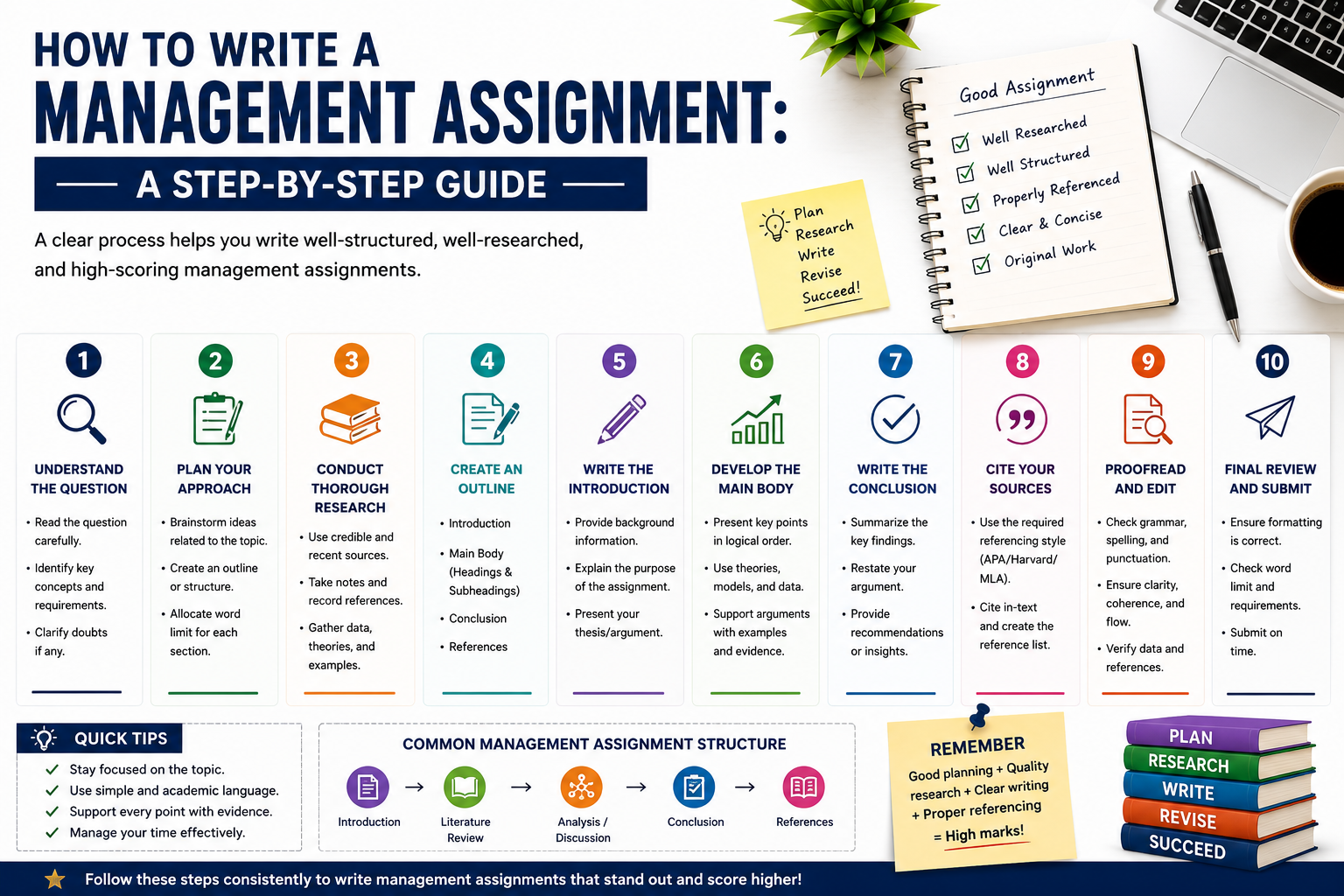
Management assignments are a staple of business school coursework, whether you're pursuing a BBA, MBA, or a specialized diploma in management studies. Unlike assignments in purely theoretical subjects, management assignments demand a blend of conceptual understanding, real-world application, analytical thinking, and clear communication. A well-written management assignment doesn't just repeat textbook definitions — it demonstrates that you can apply frameworks to actual business situations and arrive at defensible conclusions.
This guide walks you through the entire process, from understanding the question to submitting a polished final draft, with practical tips at every stage.
Step 1: Understand the Assignment Brief Thoroughly
Before you write a single word, spend real time decoding what is actually being asked. Many students lose marks not because their content is wrong, but because it doesn't answer the question that was actually set.
What to look for in the brief:
- Command words — "analyze," "evaluate," "compare," "critically discuss," and "recommend" all require different types of responses. "Discuss" invites you to explore multiple viewpoints; "evaluate" requires you to weigh evidence and reach a judgment; "recommend" expects a clear, justified course of action.
- Word count and structure requirements — note whether an executive summary, table of contents, or appendices are expected.
- Assessment criteria or rubric — if your institution provides one, treat it as a checklist. It usually reveals exactly how marks are distributed across sections like analysis, application of theory, and referencing.
- Case study or organizational context — many management assignments are built around a company case study or ask you to apply concepts to an organization of your choice. Identify this early, since your entire argument will be anchored to it.
If anything in the brief is ambiguous, clarify it with your instructor before you invest hours in the wrong direction. A five-minute question can save you a full rewrite later.
Step 2: Choose and Narrow Down Your Topic (If Not Assigned)
Some assignments give you a fixed question; others give you a broad theme and ask you to define your own angle — for example, "Discuss the role of leadership in organizational change" could apply to dozens of industries and dozens of leadership theories.
When you have this freedom:
- Pick a topic you can access credible, sufficient information about. A niche or highly private company may leave you short on data.
- Narrow broad themes into a specific, answerable question. Instead of "Employee motivation in organizations," consider "How does Herzberg's Two-Factor Theory explain motivation challenges among remote employees in the IT sector?"
- Make sure the topic allows for genuine analysis, not just description. If you can answer the question by simply summarizing a Wikipedia page, it's too descriptive for a management assignment.
Step 3: Conduct Preliminary Research
Before you build an outline, do a first pass of research to understand the landscape of the topic. This isn't your deep-dive research — it's reconnaissance.
- Skim 8–10 academic and industry sources (journal articles, case studies, reputable business publications) to see what themes, theories, and debates recur.
- Note which management theories or frameworks are commonly applied to your topic — for instance, Porter's Five Forces for competitive strategy, SWOT and PESTLE for environmental analysis, Kotter's 8-Step Model for change management, or the McKinsey 7-S Framework for organizational alignment.
- Identify any gaps, contradictions, or debates in the literature — these often make for the most interesting analytical angles in your assignment.
Keep a simple research log (source, key point, page number) as you go. This single habit will save you significant time later when you're writing in-text citations.
Step 4: Develop a Clear Thesis or Central Argument
Every strong management assignment is organized around a central argument or position — not just a topic. This is what separates an analytical assignment from a descriptive one.
Ask yourself: "After all this research, what is my answer to the assignment question?" Your answer becomes your thesis statement.
Example:
- Weak (descriptive): "This assignment will discuss motivation theories."
- Strong (argumentative): "While financial incentives remain relevant, intrinsic motivators such as autonomy and purpose are increasingly the primary drivers of engagement among knowledge workers, and organizations that rely solely on extrinsic rewards risk higher attrition."
A clear thesis gives your entire assignment direction. Every section should, in some way, build toward supporting or nuancing this central claim.
Step 5: Create a Detailed Outline
Do not skip this step, even under time pressure. An outline is what keeps a management assignment coherent rather than a loose collection of paragraphs.
A typical structure includes:
- Executive Summary (for reports) or Introduction (for essays) — states the purpose, scope, and thesis.
- Literature Review / Theoretical Framework — introduces the models and theories you will use as analytical lenses.
- Analysis / Discussion — the core section where you apply theory to your chosen case, company, or scenario.
- Recommendations (if required) — practical, specific, and justified suggestions based on your analysis.
- Conclusion — summarizes key findings and restates how they answer the original question.
- References — full academic citation list.
- Appendices (if needed) — supporting data, charts, or supplementary material.
Under each heading, jot down the specific points, theories, or evidence you plan to include. This turns writing from a blank-page problem into a fill-in-the-structure exercise.
Step 6: Write the Introduction
The introduction sets the tone and should accomplish four things in a tight, focused way:
- State the purpose and context of the assignment.
- Briefly introduce the organization or scenario under discussion.
- Outline the scope — what you will and won't cover.
- Present your thesis or central argument clearly.
Keep the introduction proportional — for a 2,500-word assignment, 150–250 words is usually sufficient. Avoid vague openers like "In today's fast-paced business world..." Instead, open with something specific to your topic.
Step 7: Build the Body — Apply Theory to Practice
This is where most of your marks are earned or lost. The body of a management assignment should never be theory alone or opinion alone — it must be an integration of both.
A reliable paragraph structure (often called PEEL) works well here:
- Point — state the idea or argument for this paragraph.
- Evidence — bring in theory, data, or a citation to support it.
- Explanation — explain how this evidence supports your point, and critically evaluate it (does the theory have limitations? does the evidence have caveats?).
- Link — connect back to your thesis or transition to the next point.
Practical tips for strong body sections:
- Don't just describe a framework (e.g., listing the five forces in Porter's model) — apply each element specifically to your case. Explain what "buyer power" looks like for this particular organization, not in general.
- Use real or plausible data where possible: market share figures, financial ratios, employee survey results, or industry statistics strengthen your analysis considerably.
- Show critical thinking by acknowledging counterarguments or limitations of the theory you're using — this is often exactly what rubrics reward under "critical analysis."
- Use subheadings generously. They make the assignment easier to navigate and show a logical structure to your marker.
- Integrate visuals thoughtfully — a well-labeled table, SWOT matrix, or simple chart can communicate more efficiently than a paragraph of prose, provided your assignment format allows it.
Step 8: Write Practical, Justified Recommendations
If your brief asks for recommendations, this section needs to move beyond "the company should improve communication." Vague advice signals weak analysis.
Strong recommendations are:
- Specific — name the action, the responsible party, and the mechanism (e.g., "implement quarterly 360-degree feedback reviews administered by HR" rather than "improve feedback").
- Justified — tied directly back to the analysis and theory covered earlier in the assignment.
- Feasible — realistic given the organization's size, resources, and industry context.
- Prioritized — if you have multiple recommendations, indicate which matter most and why.
Where possible, briefly note the expected outcome or a way to measure success (a KPI, timeline, or milestone), as this shows applied managerial thinking rather than academic abstraction.
Step 9: Write the Conclusion
The conclusion should not introduce new information. Its job is to:
- Restate your thesis in light of the evidence you've presented.
- Summarize the key findings from your analysis.
- Reiterate the most important recommendation(s), if applicable.
- End with a forward-looking or reflective statement that reinforces the significance of your argument.
Keep it concise — roughly the same length as your introduction. A strong conclusion leaves the marker with a clear sense of what you argued and why it matters.
Step 10: Reference Correctly and Consistently
Management assignments are typically assessed using Harvard, APA, or a similar academic referencing style — check your institution's required format and follow it exactly.
- Cite every theory, statistic, or idea that isn't your own, both in-text and in the final reference list.
- Use credible academic and industry sources: peer-reviewed journals, textbooks, government or industry reports, and reputable business publications (Harvard Business Review, McKinsey Insights, Financial Times, etc.). Avoid over-relying on general web content or unverified blogs.
- Keep your research log from Step 3 handy — it will make compiling an accurate reference list far faster and reduce the risk of accidental plagiarism.
- Use a reference manager (Zotero, Mendeley, or even a well-organized spreadsheet) if your assignment load is heavy, since manual citation tracking becomes error-prone at scale.
Step 11: Edit for Structure, Clarity, and Argument Strength
Once your first draft is complete, step away from it for a few hours if your timeline allows. Then edit in layers rather than trying to fix everything in one pass:
First pass — structure and argument:
- Does every section clearly connect back to your thesis?
- Is there a logical flow from introduction to conclusion?
- Are any sections purely descriptive where they should be analytical?
Second pass — clarity and conciseness:
- Cut redundant sentences and overly complex phrasing.
- Replace vague words ("various," "many," "significant") with specific ones wherever possible.
- Ensure each paragraph has one clear idea rather than several loosely connected ones.
Third pass — mechanics:
- Check grammar, spelling, and consistent formatting (headings, fonts, spacing).
- Verify all in-text citations have a matching reference list entry, and vice versa.
- Confirm you're within the word count and haven't skipped any required sections from the brief.
Step 12: Proofread and Check Against the Rubric
Before submission, do a final read-through — ideally aloud, since this catches awkward phrasing that silent reading misses. Then go back to the assessment criteria from Step 1 and check off each requirement one by one: word count, formatting, theoretical application, critical analysis, recommendations, and referencing style.
If a rubric allocates marks to "critical evaluation" or "practical application," specifically verify that these elements are visibly present in your draft — a marker should not have to search for them.
Step 13: Plan Your Time Realistically
A surprising number of weak management assignments aren't the result of poor understanding — they're the result of poor time management. Rushed research produces shallow analysis, and a rushed final edit leaves obvious errors in place. Before you begin writing, sketch a rough schedule based on your deadline.
A workable breakdown for a 2,000–3,000 word assignment might look like this:
- Days 1–2: Understand the brief, clarify doubts, and complete preliminary research.
- Day 3: Finalize your thesis and build a detailed outline.
- Days 4–6: Write the full first draft, section by section, without stopping to perfect wording.
- Day 7: Step away, then return for structural and argument-level editing.
- Day 8: Clarity and mechanics editing, plus reference list verification.
- Day 9: Final proofread and rubric check before submission.
If your deadline is shorter, compress proportionally rather than skipping stages entirely — the outline and final proofread are the two steps most worth protecting, since they have an outsized effect on quality relative to the time they take. Working in short, focused sessions with clear goals (for example, "draft the analysis section today") tends to produce better results than long, unstructured writing marathons, since fatigue is a major driver of both weak reasoning and careless errors.
It also helps to build in a buffer day before the deadline. Unexpected issues — a source that turns out to be unreliable, a formatting requirement you missed, or simply needing more time to think through your recommendations — are common, and a buffer prevents these from turning into a rushed, last-minute scramble.
Step 14: Use Feedback From Past Assignments
If you've received feedback on previous management assignments, review it before you start writing a new one. Instructors tend to flag the same types of issues repeatedly across a cohort — overly descriptive analysis, weak linkage between theory and practice, inconsistent referencing, or recommendations that aren't specific enough. Treating past feedback as a personal checklist, rather than filing it away after one glance, is one of the fastest ways to improve your grades assignment over assignment.
If your institution allows draft reviews or office hours with faculty, use them. A ten-minute conversation partway through your research can redirect a weak angle before you've invested hours writing around it.
Common Mistakes to Avoid
- Being purely descriptive. Explaining what a theory says without applying or critiquing it is one of the most common reasons management assignments underperform.
- Choosing too broad a topic. A wide-angle question forces shallow treatment of many issues instead of deep treatment of a few.
- Ignoring the specific organizational context. Generic answers that could apply to any company suggest a lack of genuine analysis.
- Overloading with theory and underloading with application. Aim for a balance — theory should serve your argument, not dominate it.
- Weak recommendations. Vague, unjustified, or impractical suggestions undercut otherwise strong analysis.
- Poor referencing. Inconsistent citation formats or missing references are an easy way to lose marks unnecessarily and risk academic integrity flags.
Final Thoughts
A strong management assignment is ultimately a demonstration of managerial thinking: the ability to diagnose a business situation using established frameworks, evaluate evidence critically, and propose a realistic path forward. It is less about proving you have memorized a set of models and more about showing you can reason through ambiguity the way a manager actually has to — weighing incomplete information, competing priorities, and practical constraints before arriving at a recommendation.
Following a structured process — understanding the brief, researching deliberately, outlining before writing, and editing in focused layers — turns what can feel like an overwhelming task into a manageable, step-by-step exercise. Each step builds on the one before it, so skipping stages under time pressure tends to cost more time later in the form of rewrites and last-minute scrambling than it saves upfront.
With practice, this process becomes faster and more intuitive. The frameworks you learn to apply well in one assignment — SWOT, PESTLE, Porter's Five Forces, Kotter's change model, or any of the dozens of others covered across a management curriculum — become tools you can reach for confidently in the next one, and the quality of your analytical writing will noticeably improve across subsequent assignments.