
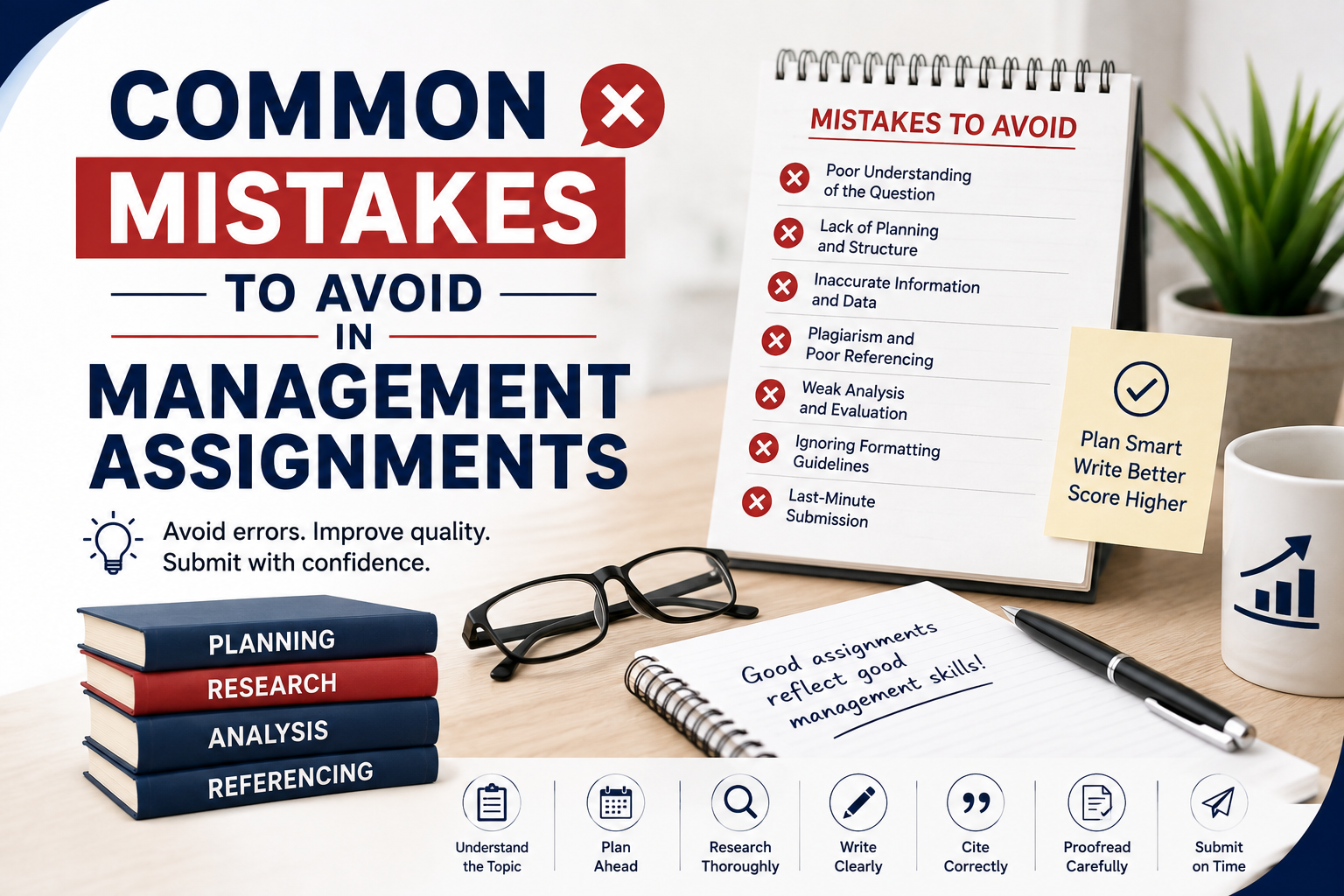
Management assignments are rarely difficult because of the subject matter alone. Most students entering a business program already have a working grasp of concepts like SWOT analysis, organizational culture, or supply chain fundamentals. Where marks are typically lost is not in understanding the theory, but in how that understanding is applied, structured, and presented within the specific conventions of academic business writing. Tutors marking these assignments tend to see the same avoidable errors repeated across cohorts, year after year.
This article walks through the most common mistakes students make in management assignments and how to avoid each one.
1. Describing Theory Instead of Applying It
One of the most frequent issues in management coursework is treating an assignment as an opportunity to summarize a theory rather than apply it. A student asked to analyze a company's market position using Porter's Five Forces, for example, might spend several paragraphs explaining what each force is in general terms, without ever connecting those forces to the specific company under discussion.
Examiners generally want to see theory used as a lens for analysis, not restated as a definition. A useful check while writing is to ask, after every paragraph, whether the content would be true of any company or only of the one being analyzed. If a paragraph could be copied into an assignment about a completely different organization without changes, it is likely too descriptive and not analytical enough.
2. Ignoring the Specific Assignment Brief
Business schools often provide detailed assignment briefs with explicit marking criteria, word limits, and required structures. A surprisingly common mistake is treating these briefs as loose suggestions rather than binding requirements. Students sometimes answer a slightly different question than the one asked, drawing on a well-rehearsed essay structure from a previous assignment instead of tailoring their response to the actual brief in front of them.
Rereading the brief after a first draft is complete, rather than only before starting, helps catch cases where the argument has drifted from what was actually asked.
3. Weak or Missing Structure
Management assignments, particularly reports and case studies, are expected to follow a clear, logical structure: often an introduction, situational analysis, discussion of options, recommendations, and conclusion. Students accustomed to essay-style writing from other disciplines sometimes default to a looser narrative structure that doesn't map onto what business report marking criteria expect.
Using clear headings and subheadings, especially in report-style assignments, is not just a stylistic preference — it often reflects directly in the marking rubric under structure or presentation criteria.
4. Overloading Assignments with Jargon
Business and management writing has its own vocabulary, and using it correctly is expected. However, some students overcorrect by packing sentences with buzzwords and jargon in an attempt to sound more academic, which often has the opposite effect. Phrases layered with terms like "synergistic value proposition" or "paradigm-shifting disruption" without clear explanation can obscure rather than strengthen an argument.
Clear, precise language, supported by evidence, is almost always favored over dense terminology used loosely.
5. Insufficient Use of Evidence
Assertions in management assignments need to be backed by evidence, whether from academic literature, company data, or industry reports. A common mistake is making a claim — for instance, that a company's culture contributed to a particular outcome — without citing a source or data point that supports it.
This is closely tied to referencing practice: every significant claim should be traceable to something a reader could independently verify, whether a journal article, an annual report, or a documented case.
6. Superficial Recommendations
Many management assignments end with a recommendations section, and this is often where quality drops sharply. Vague suggestions such as "the company should improve its marketing strategy" add little value without specificity. Stronger recommendations identify what should change, how it could realistically be implemented, and what constraints or risks might affect that implementation.
Tying recommendations directly back to the analysis presented earlier in the assignment, rather than introducing new ideas at the last minute, also tends to strengthen this section considerably.
7. Formatting and Referencing Inconsistencies
Even strong analytical work can lose marks due to inconsistent formatting — mismatched heading styles, inconsistent citation formats, or reference lists that don't match in-text citations. These issues are often the result of assignments being written over several sessions without a final formatting pass.
Reserving time at the end of the writing process specifically for formatting and referencing review, separate from reviewing the content itself, helps catch these errors before submission.
8. Poor Time Management Leading to Rushed Analysis
Many of the mistakes above stem from a single root cause: insufficient time left for revision. Analytical depth, tailored recommendations, and consistent formatting all require a full draft to already exist before they can be refined. Students who leave writing until close to a deadline often submit a first draft with little opportunity to strengthen weaker sections.
Planning backward from the deadline — allocating specific time for drafting, revising, and a final formatting check — consistently produces stronger results than writing an assignment in a single extended sitting.
Conclusion
Most of the mistakes that lower grades in management assignments are not failures of knowledge but failures of application, structure, and process. Applying theory directly to the case at hand, following the assignment brief closely, structuring work clearly, supporting claims with evidence, and leaving enough time for a genuine revision pass address the vast majority of issues that repeatedly appear in tutor feedback. None of these fixes require additional subject knowledge — they require a more deliberate approach to how that knowledge is presented.