
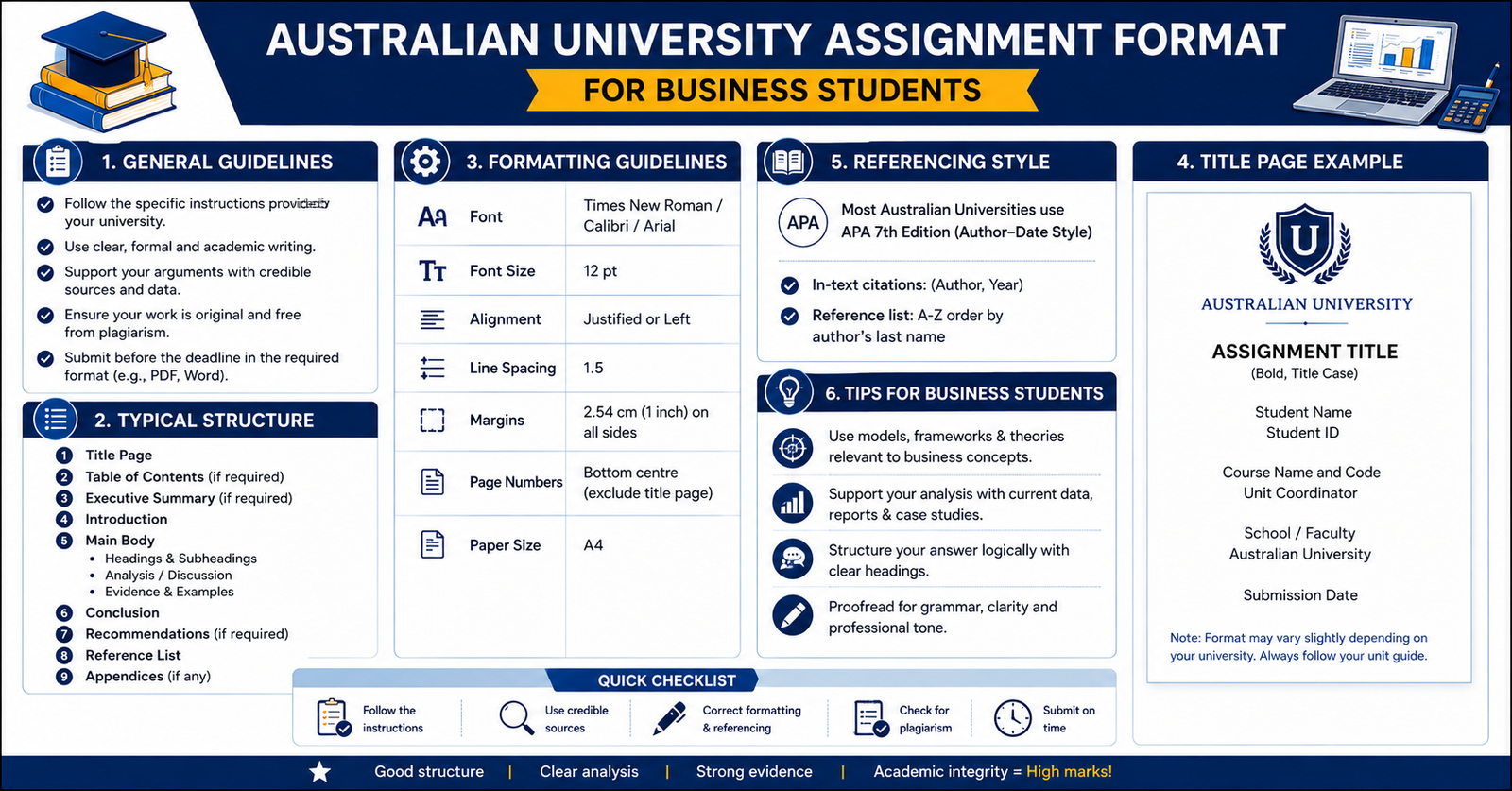
Australian universities generally expect business students to present assignments in a clear, structured, evidence-based, and academically professional format. Although exact requirements vary between universities, faculties, subjects, and individual lecturers, most business assignments follow a logical structure that includes a title page, introduction, main discussion, conclusion, and reference list. Students may also need to follow a specific referencing style, word count, formatting guide, and assessment rubric.
Understanding the correct Australian university assignment format is important because presentation is not simply about making an assignment look professional. A well-structured assignment helps demonstrate that the student understands the question, can develop a logical argument, can use credible academic sources, and can communicate ideas appropriately in a business context.
This guide explains the standard Australian university assignment format for business students, including structure, formatting, referencing, research, academic writing, tables, appendices, and common mistakes.
1. Understanding Australian Business Assignments
Business assignments in Australian universities can take several forms. Students may be asked to write essays, business reports, case studies, reflective reports, research papers, marketing plans, strategic analyses, feasibility studies, or consulting reports.
The required format depends largely on the assessment task.
For example, a traditional business essay may require continuous academic discussion, while a business report usually uses headings, subheadings, tables, recommendations, and an executive summary.
Before beginning an assignment, students should carefully read the assessment instructions. Pay attention to:
- Assignment question
- Required word count
- Learning outcomes
- Assessment criteria
- Referencing style
- Submission format
- Required sources
- Use of headings
- Report or essay requirements
- Due date
- Formatting instructions
- Requirements for appendices
- Academic integrity requirements
The assessment rubric is particularly important because it explains how the university will evaluate the assignment.
2. Standard Structure of a Business Assignment
A typical Australian university business assignment may contain the following sections:
- Title page
- Executive summary, where required
- Table of contents, mainly for reports
- Introduction
- Main body
- Analysis and discussion
- Recommendations, where required
- Conclusion
- Reference list
- Appendices, where required
Not every assignment needs every section. For example, an essay may not require an executive summary or table of contents, whereas a lengthy business report usually does.
Students should always follow the specific instructions provided by their university or lecturer when they differ from a general format.
3. Title Page
The title page provides essential information about the assignment and identifies the student and course.
A typical title page can include:
Assignment Title
Student Name
Student ID
Course or Degree
Unit Name and Code
Lecturer/Tutor Name
University Name
Submission Date
Word Count
For example:
Strategic Management Analysis of Woolworths Group
Student Name: [Name]
Student ID: [ID]
Unit: Strategic Management
Unit Code: [Code]
Lecturer: [Name]
University: [University Name]
Submission Date: [Date]
Word Count: 2,500 words
Some universities use specific title-page templates. If a template is provided, students should use it rather than creating their own design.
4. Executive Summary
An executive summary is generally required for business reports rather than traditional essays.
It provides a concise overview of the entire report and allows a business reader to understand the key findings without reading the complete document.
An executive summary may briefly explain:
- Purpose of the report
- Business problem
- Research approach
- Major findings
- Key conclusions
- Main recommendations
Although it appears near the beginning, it is usually best written after completing the report.
A strong executive summary should be concise and informative. It should not introduce completely new arguments that are not discussed elsewhere in the report.
5. Table of Contents
A table of contents is normally appropriate for longer business reports.
It should show the major headings and corresponding page numbers.
For example:
Table of Contents
- Introduction
- Company Overview
- Industry Analysis
- Competitive Environment
- Strategic Issues
- Findings
- Recommendations
- Conclusion
- References
- Appendices
Microsoft Word's automatic table-of-contents function can be used to create and update the contents page.
For short essays, a table of contents is usually unnecessary unless the lecturer specifically requests one.
6. Introduction
The introduction establishes the purpose and direction of the assignment.
A good business assignment introduction normally includes:
- Background to the topic
- Context of the business issue
- Assignment purpose
- Scope of the analysis
- Main argument or focus
- Structure of the assignment
For example, if the assignment examines the impact of digital transformation on a company, the introduction could briefly explain why digital transformation matters in the industry and identify the organisation being analysed.
The introduction should not contain excessive background information. Its purpose is to establish what the assignment will examine and how the discussion will proceed.
7. Main Body
The main body contains the detailed discussion and analysis.
This is normally the largest section of a business assignment and should be divided into logical sections.
Possible headings include:
7.1 Industry Analysis
This section may examine market trends, competitors, customer behaviour, technological changes, regulations, and other external factors.
7.2 Internal Analysis
Students may evaluate resources, capabilities, organisational structure, strengths, weaknesses, financial performance, or competitive advantages.
7.3 Marketing Analysis
Depending on the assignment, students may apply frameworks such as:
- Marketing mix
- STP analysis
- Customer journey analysis
- Consumer behaviour models
- Brand positioning
7.4 Strategic Analysis
Strategic management assignments may use frameworks such as:
- SWOT analysis
- PESTLE analysis
- Porter's Five Forces
- VRIO
- Ansoff Matrix
- Value Chain Analysis
However, students should avoid simply describing frameworks. The important part is applying the framework to the organisation and interpreting the results.
8. Analysis Versus Description
One of the most important differences between average and high-quality university assignments is the level of analysis.
Description explains what happened.
Analysis explains why it happened, what it means, and what consequences or implications may follow.
For example:
Descriptive:
The company has experienced increased competition in the Australian retail market.
Analytical:
Increased competition in the Australian retail market may place pressure on the company's pricing power and customer retention. This suggests that the organisation may need to strengthen differentiation through customer experience, digital capabilities, or product innovation rather than relying primarily on price-based competition.
The second example connects evidence to interpretation and business implications.
9. Using Evidence in Business Assignments
Australian universities generally expect students to support important claims with credible evidence.
Useful sources may include:
- Peer-reviewed journal articles
- Academic books
- Government publications
- Industry reports
- Company annual reports
- Official statistics
- Professional organisations
- Reputable business publications
Students should avoid relying heavily on unsupported websites, anonymous blogs, low-quality content websites, or AI-generated information without verification.
Evidence should support the argument rather than simply fill paragraphs with citations.
A strong paragraph generally follows a pattern such as:
Claim → Evidence → Analysis → Business implication
For example, a student may make a claim about changing consumer behaviour, provide evidence from an academic study, interpret the findings, and then explain how the change affects the selected organisation.
10. Referencing Style
Referencing is a major component of Australian university assignments.
Different universities and subjects may require different referencing systems. Common styles include:
- APA 7th edition
- Harvard
- AGLC
- Chicago
- MLA
- IEEE
Business students commonly encounter APA or Harvard referencing, but the required style should always be confirmed from the unit guide.
APA Referencing
An in-text citation may look like:
Digital transformation can influence organisational competitiveness (Smith, 2025).
A reference-list entry might contain:
Smith, J. (2025). Digital transformation and competitive advantage. Journal of Business Strategy, 20(2), 45–60.
The exact format depends on the source.
Harvard Referencing
A Harvard-style citation may look like:
Digital transformation can influence organisational competitiveness (Smith 2025).
Students should not mix referencing systems. If APA is required, the entire assignment should follow APA conventions consistently.
11. Reference List
The reference list appears at the end of the assignment.
It should include the sources cited in the assignment and should be formatted according to the required referencing style.
Students should check:
- Every in-text citation appears in the reference list.
- Every reference-list source is cited in the assignment.
- Author names are accurate.
- Publication years are correct.
- Titles are correctly formatted.
- Journal and volume information is complete where required.
- DOI or URL information is included when required.
- Referencing style is consistent.
A reference list should not be created simply by copying URLs into the final page.
12. Word Count
Australian universities normally specify a word count for each assessment.
For example, an assignment might require:
2,500 words ±10%
Students should check whether the university includes headings, quotations, in-text citations, tables, and references in the word count.
Different institutions have different rules.
Students should therefore avoid assuming that the same word-count policy applies to every Australian university.
A useful approach for a 2,500-word business essay might be:
- Introduction: 200–250 words
- Main analysis: 1,800–1,900 words
- Conclusion: 250–300 words
The exact distribution depends on the assignment question.
13. Recommended Formatting
Unless the university provides different instructions, students should use a clean and professional format.
A commonly acceptable setup may include:
- Font: Arial, Calibri, or Times New Roman
- Font size: 11 or 12 points
- Line spacing: 1.5 or double spacing, depending on requirements
- Clear headings and subheadings
- Standard page margins
- Page numbers
- Consistent paragraph spacing
- Professional table formatting
- Left-aligned body text
However, students should always prioritise the university's official formatting requirements over general recommendations.
14. Headings and Subheadings
Headings improve readability, particularly in business reports.
A logical heading structure might be:
1. Introduction
2. Industry Environment
2.1 Market Trends
2.2 Competitive Forces
2.3 Regulatory Environment
3. Internal Business Analysis
4. Strategic Issues
5. Recommendations
6. Conclusion
Headings should help the reader understand the argument. Students should avoid creating too many short sections because excessive headings can make an assignment fragmented.
15. Business Reports
Business reports differ from traditional academic essays.
A typical business report may include:
Executive Summary
Provides a concise overview.
Introduction
Explains the purpose, scope, and context.
Methodology
Explains how information was collected or analysed, when required.
Findings
Presents the key results.
Discussion
Interprets the findings.
Recommendations
Provides practical actions.
Conclusion
Summarises the major conclusions.
References
Lists cited sources.
Appendices
Provides supporting information.
The structure should be adapted to the assessment instructions.
16. Case Study Assignments
Case studies are common in business education.
A case study assignment generally requires students to identify a business problem, analyse its causes, apply relevant theories, evaluate possible solutions, and make recommendations.
A useful structure is:
- Introduction
- Company background
- Identification of key issues
- Theoretical analysis
- Evaluation of alternatives
- Recommended solution
- Implementation considerations
- Conclusion
Students should avoid simply retelling the case. The purpose is to demonstrate analytical thinking and apply academic concepts to the business situation.
17. Use of Tables and Figures
Tables, graphs, charts, and diagrams can make business assignments easier to understand.
For example, a SWOT analysis may be presented as a table:
Students should introduce and discuss every important table or figure in the written analysis.
A table should not replace critical discussion.
18. Appendices
Appendices contain supporting information that is useful but too detailed for the main body.
Examples include:
- Survey questionnaires
- Interview questions
- Detailed calculations
- Extended data tables
- Additional charts
- Financial calculations
- Supplementary research
Important arguments should remain in the main assignment rather than being hidden in an appendix.
Students should also check whether appendix material is included in the official word count.
19. Academic Writing Style
Australian university business assignments should generally use formal academic language.
Students should avoid:
- Excessive slang
- Informal expressions
- Unsupported opinions
- Overly emotional language
- Repetitive statements
- Unnecessary rhetorical questions
- Very long sentences
- Excessive first-person language when inappropriate
Instead of writing:
I think this company is doing really well because it has lots of customers.
A more academic version would be:
The company's strong customer base indicates a potentially significant competitive advantage, particularly when supported by evidence of customer retention and brand loyalty.
Academic writing should be clear rather than unnecessarily complicated.
20. Critical Thinking
Critical thinking is highly valued in Australian university assessment.
Students should compare perspectives, identify limitations, evaluate evidence, and explain implications.
For example:
Although digital transformation can improve operational efficiency, its benefits are not automatic. Organizations may face implementation costs, employee resistance, cybersecurity risks, and capability gaps. Therefore, the success of digital transformation depends not only on technology investment but also on organizational readiness and change management.
This type of discussion demonstrates evaluation rather than simple description.
21. Recommendations
Recommendations are particularly important in business reports.
A strong recommendation should be:
- Specific
- Practical
- Evidence-based
- Realistic
- Connected to the findings
- Aligned with organizational objectives
Weak recommendation:
The company should improve its marketing.
Stronger recommendation:
The company should implement a segmented digital marketing strategy focused on high-value customer groups, using customer data to personalise campaigns and evaluate conversion rates through clearly defined performance indicators.
The recommendation should explain what should be done and, where appropriate, how it can be implemented.
22. Conclusion
The conclusion brings the assignment together.
It should:
- Restate the central issue
- Summaries the major findings
- Reinforce the main argument
- Highlight important implications
- Provide a final overall judgement
The conclusion should not introduce a completely new argument or substantial evidence.
For example:
Overall, the analysis indicates that the organization's competitive position is influenced by both internal capabilities and external market pressures. While the business has several strengths, changing customer expectations and increasing digital competition require a more adaptive strategy. Strengthening digital capabilities, improving customer engagement, and developing measurable strategic objectives could therefore support sustainable competitive performance.
23. Academic Integrity
Academic integrity is a fundamental requirement at Australian universities.
Students must ensure that their work is original and that borrowed ideas, words, data, images, and research are appropriately acknowledged.
Academic misconduct may include:
- Plagiarism
- Contract cheating
- Fabricating information
- Falsifying references
- Unauthorized collaboration
- Misrepresenting another person's work as one's own
Students should understand their university's academic integrity policy before submitting an assignment.
24. Using Generative AI Responsibly
Australian universities increasingly provide specific rules regarding generative AI tools.
The rules can differ between subjects and assessments. Some assessments may permit limited AI assistance, while others may prohibit its use.
Students should check:
- Unit assessment instructions
- University AI policy
- Lecturer guidance
- Academic integrity requirements
- Whether AI use must be disclosed
- Whether an AI-use statement is required
Students should never assume that AI use is automatically permitted simply because a tool is publicly available.
Where AI assistance is permitted, students remain responsible for checking facts, references, calculations, arguments, and originality.
25. Common Formatting Mistakes
Business students frequently lose marks because of avoidable presentation problems.
Common mistakes include:
- Ignoring the assessment instructions.
- Using the wrong referencing style.
- Exceeding the word count.
- Missing page numbers.
- Using inconsistent headings.
- Providing unsupported claims.
- Including references that are not cited.
- Citing sources that cannot be verified.
- Using poor-quality online sources.
- Repeating descriptive information instead of analyzing it.
- Adding unnecessary tables.
- Introducing new information in the conclusion.
- Failing to proofread the final document.
- Submitting the wrong file format.
- Forgetting required appendices or declarations.
26. Final Assignment Checklist
Before submitting a business assignment, students should review the complete document.
Content
- Does the assignment directly answer the question?
- Is the argument clear?
- Is there sufficient analysis?
- Are theories applied appropriately?
- Are claims supported with evidence?
- Are recommendations practical?
Structure
- Is the introduction clear?
- Are sections logically organized?
- Does each paragraph contribute to the argument?
- Does the conclusion address the assignment objective?
Referencing
- Is the required referencing style used?
- Are all important claims referenced?
- Do in-text citations match the reference list?
- Have references been checked for accuracy?
Formatting
- Is the font consistent?
- Are headings clear?
- Are page numbers included?
- Are tables and figures labelled correctly?
- Is the document within the required word count?
Submission
- Is the correct file format being submitted?
- Is the correct assessment portal being used?
- Has the file been named according to university requirements?
- Has the final document been proofread?
Conclusion
The Australian university assignment format for business students is built around clarity, academic evidence, logical structure, critical analysis, and professional presentation. While requirements vary between universities and individual units, students will commonly need to organize their work around an introduction, analytical main body, conclusion, references, and—where appropriate—an executive summary, recommendations, tables, and appendices.
The most important principle is to follow the assessment brief rather than relying on a generic format. A professionally formatted assignment cannot compensate for weak analysis, but a clear structure can make strong research and reasoning easier for the assessor to recognize.
Business students should therefore focus on more than formatting. They should understand the assignment question, research credible sources, apply relevant business theories, evaluate evidence critically, develop logical arguments, and connect findings to practical business implications. Finally, the completed assignment should be checked carefully against the marking rubric, referencing requirements, word count, academic integrity rules, and submission instructions before it is submitted.