
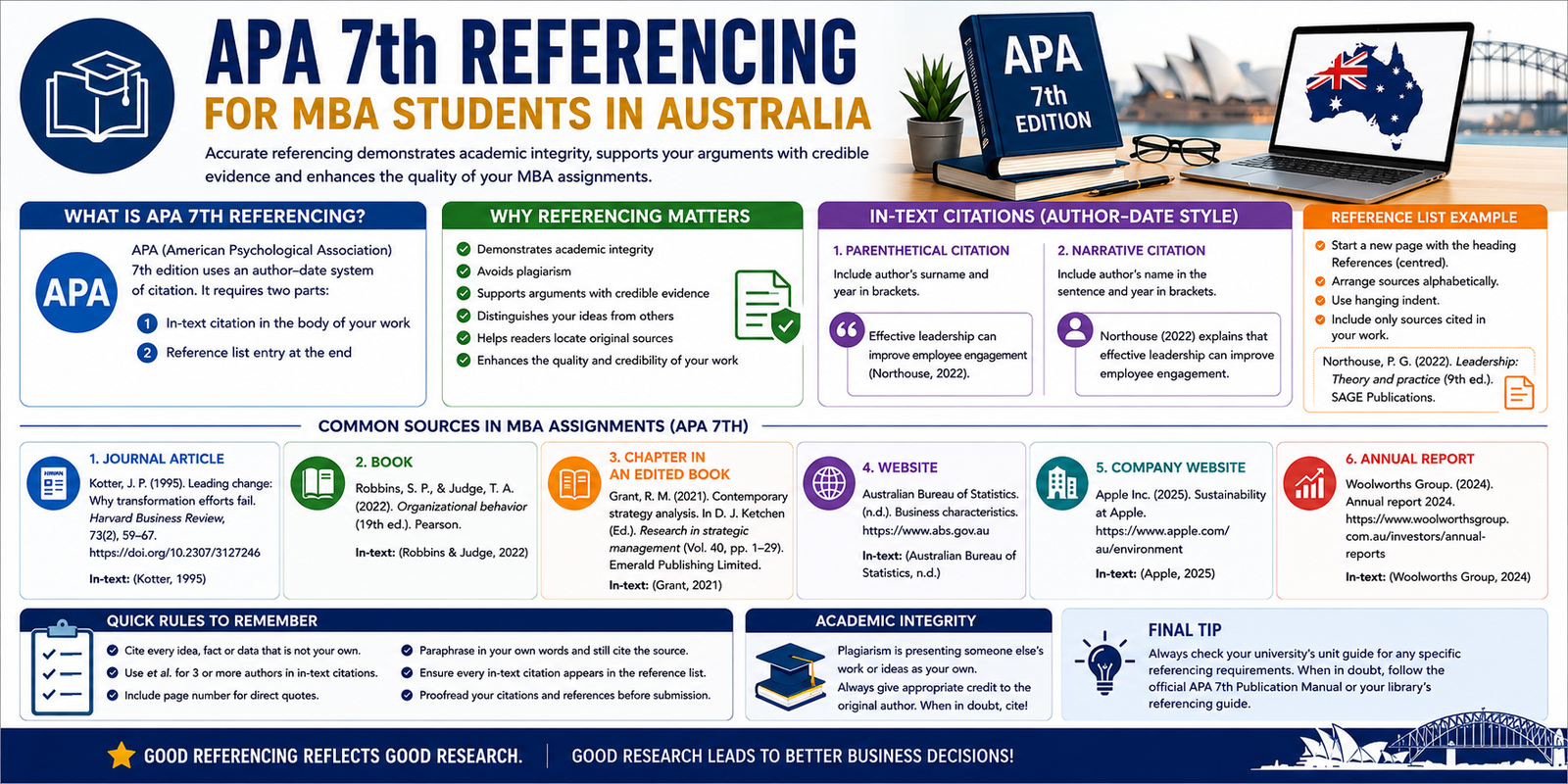
APA 7th referencing is an important academic requirement for MBA students in Australia. The American Psychological Association (APA) 7th edition referencing style provides a consistent system for acknowledging information, ideas, theories, research, and evidence obtained from other sources. Correct referencing allows students to demonstrate academic integrity, support their arguments with credible evidence, and enable readers to locate the original sources.
MBA assignments commonly require students to analyse business cases, evaluate management theories, discuss leadership practices, assess marketing strategies, examine financial performance, and make evidence-based recommendations. Because these assignments often use information from academic journals, books, company reports, government publications, websites, and industry research, students need to understand how to cite different types of sources correctly.
Although APA 7th is widely used in Australian universities, individual universities, schools, faculties, and units may provide additional requirements. Therefore, students should always check their unit guide, assessment instructions, and university referencing resources before submitting an assignment.
What Is APA 7th Referencing?
APA 7th referencing is an author-date referencing system. It generally requires two connected elements:
- An in-text citation within the assignment.
- A reference-list entry at the end of the assignment.
For example:
Effective leadership can improve employee engagement and organisational performance (Northouse, 2022).
The full source would then appear in the reference list:
Northouse, P. G. (2022). Leadership: Theory and practice (9th ed.). SAGE Publications.
The in-text citation directs the reader to the corresponding full reference.
Why Referencing Matters in MBA Assignments
Referencing is more than a formatting requirement. It demonstrates that an MBA student can build arguments using credible evidence rather than unsupported opinions.
Proper referencing helps students:
- Demonstrate academic integrity.
- Avoid plagiarism.
- Support arguments with credible evidence.
- Distinguish personal analysis from ideas taken from other authors.
- Demonstrate understanding of academic literature.
- Allow readers to locate original sources.
- Strengthen the credibility of business recommendations.
For MBA students, referencing is particularly important because management assignments often require critical analysis. A claim about leadership, organisational behaviour, marketing performance, business strategy, or financial management should ideally be supported by appropriate evidence.
In-Text Citations in APA 7th
APA 7th uses two primary forms of in-text citation: parenthetical citations and narrative citations.
Parenthetical Citation
The author's surname and publication year are placed in parentheses.
Employee motivation can influence organisational performance (Robbins & Judge, 2022).
Narrative Citation
The author's name becomes part of the sentence, while the year appears in parentheses.
Robbins and Judge (2022) explain that employee motivation can influence workplace behaviour and organisational outcomes.
Both formats are acceptable. Students can choose the format that best suits the structure of their argument.
Direct Quotations
When students use the exact words of another author, quotation marks and an appropriate citation are required.
For a short quotation:
“Leadership is a process whereby an individual influences a group of individuals to achieve a common goal” (Northouse, 2022, p. 6).
The page number should be included for a direct quotation from a paginated source.
For longer quotations, APA 7th uses a block-quotation format. However, MBA students should generally avoid excessive quotation. Academic assignments are usually stronger when students paraphrase research and demonstrate their own understanding and analysis.
Paraphrasing
Paraphrasing means expressing another author's ideas in your own words while retaining the original meaning.
For example:
Effective leaders can influence group behaviour by establishing a shared direction and encouraging employees to work towards common objectives (Northouse, 2022).
Even when information is paraphrased, the original source must still be cited.
A common mistake is changing a few words from the original sentence and calling it paraphrasing. Good academic paraphrasing requires genuine understanding and restructuring of the source material.
Reference List
The reference list appears at the end of the assignment and contains the complete details of sources cited in the text.
In general, the APA 7th reference list:
- Starts on a new page.
- Uses the heading References.
- Lists sources alphabetically by the first author's surname.
- Uses a hanging indent.
- Includes only sources cited in the assignment.
- Provides enough information for readers to locate the source.
For example:
References
Northouse, P. G. (2022). Leadership: Theory and practice (9th ed.). SAGE Publications.
Students should ensure that every in-text citation has a corresponding reference-list entry and that every reference-list entry has been cited in the assignment, unless their university provides different instructions.
Referencing a Journal Article
Academic journal articles are particularly valuable for MBA assignments because they provide peer-reviewed research.
A general APA 7th format is:
Author, A. A. (Year). Title of article. Title of Journal, volume(issue), page–page. https://doi.org/xxxxx
Example:
Kotter, J. P. (1995). Leading change: Why transformation efforts fail. Harvard Business Review, 73(2), 59–67.
In-text citation:
(Kotter, 1995)
Journal literature can be particularly useful when students need to support theoretical arguments about leadership, organisational change, strategic management, marketing, human resources, or innovation.
Referencing a Book
A general APA 7th book format is:
Author, A. A. (Year). Title of book (Edition). Publisher.
Example:
Robbins, S. P., & Judge, T. A. (2022). Organizational behavior (19th ed.). Pearson.
In-text citation:
(Robbins & Judge, 2022)
For a narrative citation:
Robbins and Judge (2022) argue that organisational behaviour is influenced by factors operating at individual, group, and organisational levels.
Referencing a Chapter in an Edited Book
When using a chapter written by a different author in an edited book, students should reference the chapter rather than simply referencing the entire book.
A general structure is:
Author, A. A. (Year). Title of chapter. In A. A. Editor (Ed.), Title of book (pp. xx–xx). Publisher.
Students should check the exact publication details of the source they are using rather than relying on a generic example.
Referencing Company Websites
Business assignments frequently use information from company websites. This may include information about corporate strategy, products, sustainability, leadership, financial performance, or organisational policies.
A general APA 7th format is:
Organisation Name. (Year). Title of webpage. URL
For example, information about a company's sustainability strategy could be cited in text as:
(Apple, 2025)
The reference should provide the organisation name, publication date where available, webpage title, and URL.
Students should distinguish between information published by a company itself and independent analysis of that company. A company's own website may be appropriate for factual information about its products, policies, or stated strategy, but academic arguments may benefit from independent scholarly or industry sources as well.
Referencing Annual Reports
Annual reports can be highly useful for MBA assignments involving financial performance, corporate governance, sustainability, strategy, and organisational analysis.
A typical reference includes:
Organisation Name. (Year). Title of annual report. URL
For example, students analysing a company's financial performance may use its annual report alongside academic literature and independent industry data.
Annual reports should not necessarily be the only source used. Combining corporate reports with academic research can provide a more balanced analysis.
Referencing Government and Industry Reports
Government publications and industry reports can provide valuable evidence for MBA assignments.
Examples include:
- Australian government reports.
- Australian Bureau of Statistics publications.
- Reserve Bank of Australia reports.
- Industry association reports.
- Regulatory publications.
- Market research reports.
Students should record the organisation responsible for the publication, year, report title, and relevant URL or publisher information according to APA 7th requirements.
Referencing Websites
A webpage reference generally includes:
Author or organisation. (Year, Month Day). Title of webpage. Website Name. URL
If the author and website name are effectively the same, APA conventions may not require repeating the website name.
Students should also check whether a webpage has a publication date. If no date is available, APA 7th may use n.d., meaning “no date.”
Example:
Australian Bureau of Statistics. (n.d.). Business characteristics. [URL]
The actual reference should be constructed using the details available on the specific webpage.
Multiple Authors
APA 7th has specific rules for sources with multiple authors.
For a source with two authors, both surnames are included in every in-text citation.
(Robbins & Judge, 2022)
For a source with three or more authors, use the first author's surname followed by et al.
(Smith et al., 2024)
Students should ensure that author names and publication years are accurately recorded.
Multiple Sources in One Citation
Sometimes several studies support the same argument. Multiple sources can be included in one parenthetical citation.
For example:
Employee engagement can influence productivity, retention, and organisational performance (Author, 2021; Author & Author, 2022; Author et al., 2024).
This can demonstrate that an argument is supported by multiple sources rather than a single study.
Tables and Figures
MBA students frequently use tables, graphs, charts, and figures to present business information.
When a table or figure is reproduced or adapted from another source, appropriate attribution is required. Students should also follow their university's requirements regarding captions, notes, formatting, and placement.
For example:
Figure 1
Annual Revenue Growth
A note below the figure can identify the source when required.
Students should avoid copying charts from websites without acknowledging the original source.
APA 7th Formatting for MBA Assignments
Referencing is only one component of academic presentation. Students should also follow the formatting requirements specified by their university.
Common academic formatting may include:
- Clear and readable font.
- Consistent font size.
- Appropriate line spacing.
- Standard page margins.
- Page numbers.
- Clear headings and subheadings.
- Consistent paragraph structure.
- Correct reference-list formatting.
- Appropriate presentation of tables and figures.
However, students should not assume that every Australian university uses exactly the same formatting requirements. The unit guide and assessment instructions should take priority.
Academic Integrity and Plagiarism
One of the most important reasons for learning APA 7th referencing is academic integrity.
Plagiarism occurs when a student's work presents another person's words, ideas, data, or intellectual contribution as their own without appropriate acknowledgement.
Common examples include:
- Copying sentences without quotation marks and citation.
- Using another author's ideas without attribution.
- Copying information from a website without referencing it.
- Submitting another person's work as your own.
- Incorrectly paraphrasing source material.
- Providing citations that do not correspond to the actual sources used.
Correct referencing helps students demonstrate that their work is based on legitimate research and that they understand the difference between their own analysis and information obtained from other sources.
Common APA 7th Mistakes by MBA Students
Several mistakes occur frequently in business and management assignments.
1. Missing In-Text Citations
Students sometimes include a reference list but fail to cite sources within the body of the assignment.
2. Incomplete Reference Details
Missing publication years, authors, titles, publishers, or URLs can make sources difficult to locate.
3. Incorrect Author Formatting
Author names should follow APA conventions rather than being written in an informal format.
4. Overuse of Direct Quotes
MBA assignments should demonstrate the student's ability to interpret and apply research. Excessive quotations can reduce opportunities for independent analysis.
5. Inconsistent Formatting
Mixing different referencing styles can make an assignment appear poorly prepared.
6. Relying Only on Websites
Business websites can be useful, but academic assignments should generally include appropriate scholarly literature where required.
7. Using Outdated Evidence
Older research can still be valuable, particularly for established theories, but current business issues should generally be supported with relevant and recent evidence.
How to Improve APA Referencing in an MBA Assignment
Students can improve their referencing process by recording source information while conducting research rather than trying to reconstruct references at the end.
A useful research record can include:
Reference-management software can also help organise sources, but students should always check automatically generated references against APA 7th requirements. Software can make formatting errors, especially when source metadata is incomplete.
Recommended Structure for APA-Based MBA Assignments
A typical MBA assignment may follow a structure such as:
- Title page
- Introduction
- Main analysis
- Relevant theories and frameworks
- Business examples or case analysis
- Critical discussion
- Recommendations
- Conclusion
- References
- Appendices, if required
The exact structure will depend on the assessment question and university requirements.
APA referencing should be integrated throughout the assignment rather than added only at the end.
Final APA 7th Checklist for MBA Students
Before submitting an assignment, students can use the following checklist:
- Check the university's specific referencing requirements.
- Confirm that APA 7th is the required style.
- Ensure every borrowed idea has appropriate attribution.
- Check every direct quotation for quotation marks and page or location information where required.
- Ensure in-text citations correspond with reference-list entries.
- Arrange references alphabetically.
- Check author names and publication years.
- Check titles, journal details, publishers, DOIs, and URLs.
- Use consistent formatting throughout the reference list.
- Check tables, figures, and adapted material for appropriate attribution.
- Review the assignment for accidental plagiarism.
- Proofread citations before submission.
Conclusion
APA 7th referencing is an essential academic skill for MBA students in Australia. It provides a consistent method for acknowledging academic research, business reports, company information, websites, books, journal articles, and other sources used in management assignments.
Effective referencing strengthens an assignment because it demonstrates that arguments are based on credible evidence. It also allows students to distinguish their own analysis from the ideas and information obtained from other sources. For MBA students, this is particularly important because assignments frequently require evidence-based evaluation of real organizations and strategic management issues.
Students should remember that accurate referencing is not simply a technical requirement. It is part of effective academic communication and academic integrity. The best approach is to use credible sources, cite them consistently, paraphrase responsibly, and maintain accurate reference records throughout the research process.
Finally, APA 7th rules should always be checked against the specific requirements of the Australian university, faculty, and unit. Where local instructions differ from general APA guidance, the assessment or unit guide should be followed. By developing strong APA 7th referencing habits, MBA students can improve the credibility, professionalism, and academic quality of their assignments.